







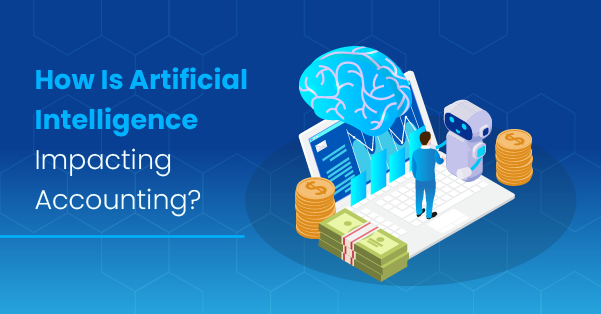
As artificial intelligence (AI) keeps getting better at a speed that has never been seen before, it is having an impact on many fields, including accounting. The careers of accountants are at a crossroads where taking AI courses for accountants is not just a choice but a must if they want to stay competitive. The stakes are high because using AI technologies could make things easier, help people make better decisions, and even change the jobs of people in the accounting field.
Not only is it important for accountants to improve their AI skills to protect their jobs, but taking AI courses for accountants can also help them make their work more productive and efficient. Some ways AI has changed accounting are by automating monotonous tasks and giving us better ways to look at data. AI courses for accountants are important for modern accountants, and accountants need to keep their skills up to date and use AI to stay current.
AI courses for accountants are one of the best ways to learn new skills and get a better grasp on how to use AI. AI courses and certifications are designed to give accountants the information and skills they need to successfully and efficiently use AI in their work.
This article talks about some of the best AI courses for accountants and certifications that will help you stay competitive in the accounting and finance industries.
Table of Contents
Why AI is Important for Accountants Today
The significance of AI for accountants is further emphasized by the pervasive adoption trends, as reports suggest that 69% of businesses are already utilizing AI in some capacity. This broad adoption is a testament to the potential of AI to transform traditional accounting procedures by introducing automation, boosting accuracy, and providing deeper insights.
The objective of this article is to help accountants and other professionals identify the most appropriate AI courses for accountants that will provide them with the requisite skills and knowledge to excel in an AI-augmented work environment.
The Increasing Influence of AI on Accountants
AI is being implemented in a variety of accounting applications, such as the automation of repetitive duties, the improvement of data analysis capabilities, and the customization of client interactions. Perhaps the most immediate advantage is automation, which enables accountants to delegate routine tasks and concentrate on more strategic responsibilities.
AI-powered tools empower accountants to derive actionable insights from extensive datasets, thereby enhancing the quality of their decisions and promoting more well-informed financial strategies. Additionally, AI improves client services by customizing financial advice and solutions to the individual requirements of each client, thereby enhancing client satisfaction and relationships.
The Best AI Courses for Accounting: Key Features to Consider
It is crucial to take into account a few key variables when selecting AI courses for accountants to guarantee that it is in accordance with your career aspirations and educational objectives:
1. Relevance to Real-World Financial Situations:
The AI courses for accountants should incorporate real-world case studies and practical applications to facilitate your comprehension of the practical applications of AI in real-world accounting and finance environments.
2. Course Length and Flexibility:
Consider whether you require a more organized in-person program or a more flexible online AI course for accountants, based on your schedule. The most suitable AI courses for accountants should be compatible with your professional responsibilities and not result in excessive tension.
3. Case Studies and Practical Applications:
An AI courses for accountants that prioritizes practical learning through real-world case studies and hands-on tasks will offer a significantly more profound comprehension of the operation of AI in the finance sector.
4. Industry-experienced instructors:
The AI courses for accountants material can be made more relevant, and invaluable insights can be gained by learning from experts who have real-world experience in both AI and finance.
5. Student Success Stories and Peer Reviews:
Search for AI courses for accountants that have received favorable reviews and have produced successful alumni. This is frequently a reliable indicator of the course’s quality and its capacity to equip you with valuable skills that will facilitate your career advancement.
Related Posts: Best Text To Animation AI Tools
Benefits of working as an AI expert in the field of accounting
There are several advantages for accounting professionals to become proficient in AI. By acquiring AI expertise, accountants can substantially improve their career prospects and uncover new opportunities within the industry. Possessing skills in any AI courses for accountants can result in increased employability and potentially higher earning potential, as they are in high demand.
Additionally, accountants are able to make a more significant contribution to their organizations by adopting AI expertise, which facilitates the optimization of processes, the reduction of errors, and the promotion of innovation. The leaders and innovators of tomorrow are likely to be those who invest in mastering these technologies today, as AI continues to evolve.
This article will evaluate AI courses for accountants that are specifically designed for accountants, including the Complete AI Training, which provides a comprehensive selection of video courses and certifications that are specifically tailored to the accounting profession. The objective of these courses is to provide accountants with the requisite AI skills to excel in their careers, emphasizing the key features and benefits to assist readers in making informed decisions regarding their professional development.
The Core Skills Required to Learn AI for Accounting
A combination of technical and analytical skills is required for professionals to successfully implement AI in accounting and finance.
Key areas of expertise include:
- Data Analysis and Interpretation: AI is fundamentally rooted in the capacity to analyze extensive datasets and extract valuable insights. It is essential to comprehend the interpretation of these insights in order to make well-informed financial decisions.
- Basics of Machine Learning: By recognizing patterns in data, machine learning enables AI to enhance its capabilities over time. Professionals will be able to optimize the utilization of these instruments by acquiring a fundamental comprehension of the operation of machine learning algorithms.
- Predictive analytics: A critical component of finance, as it applies artificial intelligence to predict future financial trends. To maximize their strategies and enhance outcomes, finance professionals can benefit from comprehending the operation of predictive models.
- Natural Language Processing (NLP): NLP is a technology that allows machines to understand human language. Sentiment analysis is a common application of this in the financial sector. Which can assess market sentiment by analyzing news articles or social media posts.
Types of AI Courses for Accounting and Finance Professionals
Finance and accounting professionals have access to a diverse selection of AI courses for accountants. Diverse learning styles and career objectives are accommodated by each. These AI courses for accountants explore a wide spectrum of options, including formal degree programs and free online courses.
Let us explore the key categories of AI courses for accountants that are accessible:
A. In-Person Classes vs. Online Courses:
Online AI courses for accountants are frequently more cost-effective and adaptable, rendering them an optimal choice for professionals who must reconcile their professional obligations with their educational pursuits. In contrast, in-person seminars may provide more opportunities for networking and hands-on experience.
B. Paid vs. Free Courses:
Free AI courses for accountants are an excellent starting point for individuals who are either new to AI or are interested in investing in it as a new skill. Certification, real-world case studies, and more comprehensive materials are frequently included in paid courses, which can be advantageous for career advancement.
C. Certification Courses vs. Degree Programs:
A comprehensive training and an established basis in AI are provided by degree programs, such as a master’s in data science or AI. AI courses for accountants are an excellent choice for professionals who wish to rapidly enhance their skills, as they are generally brief and more concentrated on specific competencies.
D. Bootcamps:
AI bootcamps are broad, short-term programs that are intended to provide individuals with practical AI skills promptly. Those seeking to delve deeply into AI for accounting and finance in a brief amount of time will find these programs to be ideal, as they frequently emphasize real-world applications and hands-on learning.
Reasons for Accountants to Consider AI Certifications
It is important to recognize the significance of obtaining these credentials before we delve into the most beneficial AI courses for accountants :
1. Maintain a Competitive Edge:
To automate tasks such as payroll, audits, and other forms of analysis, AI is becoming a standard technology in accounting firms. In order to maintain a competitive edge, accountants must be able to effectively implement AI to enhance their accounting practices.
2. Enhance Career Opportunities:
Within the accounting profession, there is a significant demand for AI experts. Individuals who include AI certifications and other AI courses for accountants in their resumes will have a competitive edge when applying for positions at higher levels within their organizations or with organizations that offer higher compensation.
3. Enhance Efficiency:
Accountants will be able to execute work more accurately and efficiently, and allocate more time for strategic initiatives, by learning how to access and use AI tools through AI courses for accountants.
4. Maintain Relevance:
AI is here to stay, and accountants are no longer able to opt out; it is now a necessity. AI courses for accountants will enable accountants to remain informed about the most recent tools, techniques, and applications that facilitate their work.
5. Proof of the Future:
In a professional environment that is perpetually evolving, AI is a dynamic skill set. Accountants who dedicate time and effort to acquiring technological skills in AI courses for accountants will be more adaptable in the future than those who do not.
Related Posts: Best AI Icon Generators
What Describes an Excellent AI Courses for Accountants?
Particularly for finance professionals, not all AI courses for accountants are equal. Here are the indicators to observe:
- Industry-Specific Content -A neural network is the subject of generic AI courses. A finance AI course for accountants that is exceptional will instruct you on the methods by which AI detects illicit transactions, forecasts revenue, or automates audit procedures. Search for AI courses for accountants that include case studies and finance examples.
- Practical, Not Just Theoretical – You should be able to implement a new skill in your professional life upon completion of an AI courses for accountants. Hands-on exercises, actual datasets, and tool walkthroughs are all components of the most effective courses, as opposed to mere slides that describe the potential capabilities of AI.
- No Unwarranted Prerequisites – Many finance professionals lack a computer science background, and that is acceptable. The ideal AI courses for accountants start with the fundamentals and progress from there. If a course assumes that you are familiar with Python prior to teaching AI in finance, it is not meeting the expectations (unless it is a Python for AI courses for accountants).
- Relevant Content – Artificial intelligence tools undergo fast development. An AI courses for accountants that exclusively addresses AI from the year 2023 is already outdated. Search for content that discusses contemporary AI assistants, such as GPT-4, Claude, and Gemini, as well as the current automation tools employed in the finance industry.
- Acknowledged Credentials – Free certificates can still be considered significant, particularly when they are issued by reputable platforms. Seek out AI courses for accountants that offer verifiable completion certificates that you can include in your LinkedIn profile.
How to Select an AI Course for Accountants
AI is revolutionizing the accounting industry, and the appropriate AI courses for accountants can provide you with practical skills that will significantly enhance your daily work. The following are the criteria to consider to guarantee that the AI courses for accountants you select provide immediate, actionable benefits.
A. Encourage collaboration between humans and artificial intelligence:
The most effective courses emphasize the potential for humans and AI to collaborate, rather than to supplant one another. Programs that instruct “Human in the Loop” concepts are to be sought, in which artificial intelligence manages repetitive tasks while you maintain authority over critical decisions.
Research indicates that accountants who strategically implement AI achieve the most significant performance enhancements. These AI courses for accountants assist in redirecting your attention from routine tasks to more valuable endeavors, such as strategic analysis, client communication, and professional judgment.
B. Real-World Accounting-Oriented Practical Applications:
Adopt AI courses for accountants that explore real-world accounting scenarios. For example, they should instruct you on the application of predictive analysis to financial data, the utilization of AI for fraud detection, and the automation of tasks such as data entry and invoice processing. Utilizing practical applications such as these guarantees that the competencies you acquire are immediately applicable to your occupation.
C. Data Quality and Bias Awareness Training:
The quality of AI is contingent upon the data it employs. AI courses for accountants that are effective emphasize the significance of data quality and instruct students on how to identify and rectify biases in AI systems. This guarantees the precision and dependability of your AI-driven analyses.
D. Focus on US regulations and compliance requirements:
It is imperative to select an AI courses for accountants that addresses local regulations and business practices if you are employed in the United States. For instance, the course should delineate the manner in which AI tools adhere to standards such as ASC 842 for lease accounting, manage US currency formats, and operate within the US regulatory framework. In a highly regulated environment, this knowledge is indispensable for ensuring compliance.
E. Development of critical thinking and judgment skills:
Although AI has the potential to offer valuable insights, accountants must continue to critically evaluate its outputs. The most efficient AI courses for accountants instruct you on how to interpret AI confidence scores and apply professional judgment to prevent errors and guarantee regulatory compliance.
F. Practical Training with Appropriate Instruments
Practical experience is indispensable. Search for AI courses for accountants that provide practical training with tools that accountants actually employ, such as AI-integrated accounting software or generative AI for technical research and writing. This type of training guarantees that you can promptly implement the knowledge you have acquired in your daily work.
G. Adaptable Learning Options:
Flexibility is important if you have a busy schedule. Several accountants favor self-paced online AI courses for accountants that are designed to accommodate client deadlines, tax season, or month-end closings. These AI courses for accountants enable you to pursue your education at your own pace without interfering with your professional obligations.
H. Professional Recognition and Accreditation:
An AI courses for accountants that has been properly accredited enhances the credibility of your resume and assures employers and clients of your expertise. Furthermore, certain programs provide continuing professional education (CPE) credits, which enable you to fulfill annual certification requirements while simultaneously developing your AI capabilities.
Can AI do Accounting Tasks?
Yes, AI can considerably automate accounting processes such as bookkeeping, data extraction from invoices, expense classification, bank reconciliation, and financial report generation. It improves efficiency by substituting manual data entry, but it is best suited as a labor-enhancing tool, assisting professionals rather than completely replacing human judgment.
Key Accounting Tasks that AI Performs
- Bookkeeping and Data Entry: AI tools such as AI Accountant and Gusto automatically read invoices, receipts, and bank statements, retrieving information with high accuracy (sometimes up to 95%).
- Expense Categorization and Reconciliation: AI organizes transactions and links them to invoices, as shown in Ramp and BILL.
- Auditing and analysis: Platforms such as Kira Systems sift through hundreds of contracts to gather data for audit reports.
- Predictive Cash Flow and Reporting: Sage Copilot uses AI to identify patterns and predict cash flow while also generating real-time financial reporting.
Real-World Applications of Artificial Intelligence in Finance
To understand the significance of these AI courses for accountants, the following are specific examples of how finance professionals currently utilize AI:
Financial Analysis and Reporting
- Financial summary: AI generates financial summaries from raw data through automated report generation.
- Pattern identification: AI identifies peculiar patterns in P&L statements through variance analysis.
- NLQ – Inquire about financial data in straightforward English using natural language queries.
Compliance and Audit
- Anomaly detection: Artificial intelligence detects suspicious transactions in millions of records.
- Review: AI extracts critical data elements from invoices and contracts during document review.
- Regulatory monitoring: Artificial intelligence monitors regulatory modifications that impact your organization.
Planning and Forecasting
- Revenue forecasting: Machine learning models that learn from historical patterns
- Scenario modeling: Artificial intelligence generates thousands of scenarios in a matter of seconds.
- Cash flow prediction: More precise short-term cash flow forecasts
Risk Management
- Credit scoring: Artificial intelligence models that more precisely evaluate risk
- Real-time risk monitoring and alerting: Market risk analysis
- Fraud prevention: Pattern recognition that detects fraud that humans would overlook
Getting Ready for the Integration of AI in Accounting
Here are a few strategies to enhance your foundation for learning in order to optimize these AI certifications and AI courses for accountants:
- Establishing objectives: Determine if the emphasis would be on strategic applications of AI, data analytics, or automation.
- Choose a program: Select an AI courses for accountants that is consistent with your professional goals and abilities.
- Invest in education: AI is a field that is rapidly evolving, and there will be a plethora of new tools released in the future. Therefore, it is important to anticipate and remain informed about these developments.
- Knowledge application: Demonstrate and enhance your value by applying your knowledge to the use of AI tools in your professional environment.
Best AI Courses for Accountants
1. Upskilling: AI for Accountants Program:

This program earned a spot on the list because of its practical and adaptive approach. Upskillist’s AI for Accountants Program is designed for professionals who want to seamlessly integrate AI into their accounting procedures. It provides hands-on training that may fit into even the most hectic schedules.
The training emphasizes the balance of AI tools and human knowledge. It educates accountants how to use AI for chores such as data entry and invoice processing, freeing up time for making strategic choices and client-facing work. Here’s a closer look at what makes this application an excellent choice for accountants who want to embrace AI.
Flexibility and Learning Format
The program’s on-demand model is ideal for busy professionals. You can go at your own pace, pause when things become crazy, and resume just where you stopped. Learning resources are diverse, including videos, notes, and slides, so you can select the format that best suits you.
Cost (USD) and Value for Money
For $39.99 each month, you have unlimited access to over 80 courses, each with 20 hours of practical training. The application has an amazing 4.8/5 user rating, and a 7-day free trial allows you to test the platform without making a long-term commitment.
Accreditation & Recognition
Completing the AI courses for accountants offers you a globally recognized certification, as well as module-based credentials from reputable colleges. These qualifications are supported by ongoing exams, ensuring that your skills are fully recognized.
2. AI Tools and Strategies for Accountants (CPA Alberta, CPA Western Provinces):
This training is designed to help accountants integrate AI into their regular job. It was developed by CPA Alberta in collaboration with CPA Western Provinces and focuses on how to apply popular AI tools such as Microsoft Copilot and ChatGPT in real-world accounting applications. We’ll look at its accreditation, hands-on applications, and flexible learning style in the next sections.
Accreditation & Recognition
When you finish this course, you will receive 4 Continuing Professional Development (CPD) hours. Although the curriculum is given by Canadian accounting groups, it is intended for accountants worldwide. Accountants in the United States, in particular, can benefit from the skills provided here, which address universal concerns such as increasing efficiency, managing risks, and making ethical decisions. These topics are directly related to the professional requirements required in the US accounting sector.
Accounting’s practical applications
The AI courses for accountants teach not just the theory of AI, but also how to apply it. You’ll learn how to incorporate AI technologies into your existing workflows, improving your capacity to make solid professional decisions rather than relying on complete automation. The goal is to use AI to supplement your expertise rather than replace it.
Flexibility and Learning Format
One of the most notable aspects of this course is how accessible it is. The material is provided in simple terms, making it understandable even if you are not a tech expert. There is no need to get into programming or complex technical intricacies. Instead, the course teaches you how to quickly identify chances to use AI technologies in common work. It’s meant to provide you with actionable skills so you can start using AI effectively right away. This practical approach ensures that you are prepared to address the increasing demand for AI expertise in the accounting profession.
3. AI for Business Specialization (University of Pennsylvania):
The Wharton School at the University of Pennsylvania has a concentration that investigates how AI might improve strategic decision-making. While not designed expressly for accountants, the program delves into AI ideas that are extremely important to areas such as financial analysis, risk management, and business intelligence. This program establishes a solid basis for using AI in professional settings by combining business knowledge and AI principles.
Accreditation & Recognition
This specialization is supported by the prominent Wharton School and taught by qualified faculty members. Participants who finish the program are awarded a credential from the University of Pennsylvania, highlighting the school’s emphasis on integrating AI with business strategy.
Accounting’s practical applications
Rather than concentrating on technical programming, the program emphasizes strategic applications of AI, making it especially useful for accountants. Topics covered include analyzing AI-powered initiatives, using machine learning for financial prediction, and creating AI frameworks. It also addresses essential issues such as ethics and compliance in financial reporting and auditing, providing accountants with practical tools to improve their decision-making abilities in financial responsibilities.
Flexibility and Learning Format
The program is given in self-paced courses, which makes it accessible to busy professionals. It combines video lectures, case studies, and hands-on projects to simulate real-world business difficulties, providing a practical mix of theory and application.
Cost and Value for Money
Enrollment fees and dates vary, but the program is a more affordable method to develop strategic AI experience than standard degree programs.
4. AI in Finance Specialisation (CFTE):
The Centre for Finance, Technology, and Entrepreneurship (CFTE) has launched the first online AI in Finance Specialization, which is intended to walk professionals through the fundamentals of AI and its applications in the finance industry. This curriculum delves into the benefits and problems of using AI, making it an excellent resource for accountants interested in learning how artificial intelligence might transform their careers.
Accreditation & Recognition
This curriculum is accredited in collaboration with Ngee Ann Polytechnic and recognized by CPD, ACT, and the IBF. Upon completion, participants receive a certificate from CFTE, which they can display on platforms such as LinkedIn. The accreditation not only increases professional reputation, but it also matches practical accounting requirements.
This curriculum is supported by the AI in Finance Academy, which has previously trained over 20,000 professionals throughout the world. Participants benefit from insights offered by 72+ industry professionals from leading companies, including Citi, UBS, and PwC. These professionals have firsthand knowledge of how AI is being used in prominent financial firms.
Accounting’s practical applications
The training provides accountants with tools for optimizing financial procedures, improving reporting accuracy, and increasing analytical capabilities through the use of AI and machine learning. These skills are consistent with the broader trend of employing artificial intelligence to improve efficiency and assist strategic accounting decisions.
This curriculum is transformative for accountants looking to advance their careers. It opens up chances for roles at the confluence of finance and technology, such as open banking and fintech. By learning AI, professionals may position themselves for employment in a quickly changing financial sector, ensuring their competitive advantage.
Flexibility and Learning Format
This curriculum is designed to accommodate hectic schedules, with a self-paced online style. The structured curriculum includes the most recent AI advancements, allowing participants to study at their own pace while maintaining their professional duties.
Input from leaders in financial institutions, startups, investment firms, and regulatory organizations enhances the learning experience. This diversity of viewpoints guarantees that participants receive a thorough understanding of how AI is influencing various aspects of the finance industry.
Cost and Value for Money
The AI in Finance Specialization costs £600 (about $720 USD), excluding 20% VAT. CFTE also allows you to pay in three interest-free installments of £200 (excluding VAT).
This program is highly regarded by financial professionals and provides a great return on investment. With its extensive curriculum, expert-led instruction, and various accreditations, it is an ideal option for accountants who want to add AI experience to their professional toolset.
Related Posts: AMAZING AI STORY GENERATORS
5. AI for Business and Finance (Columbia Business School Executive Education x Wall Street Prep):
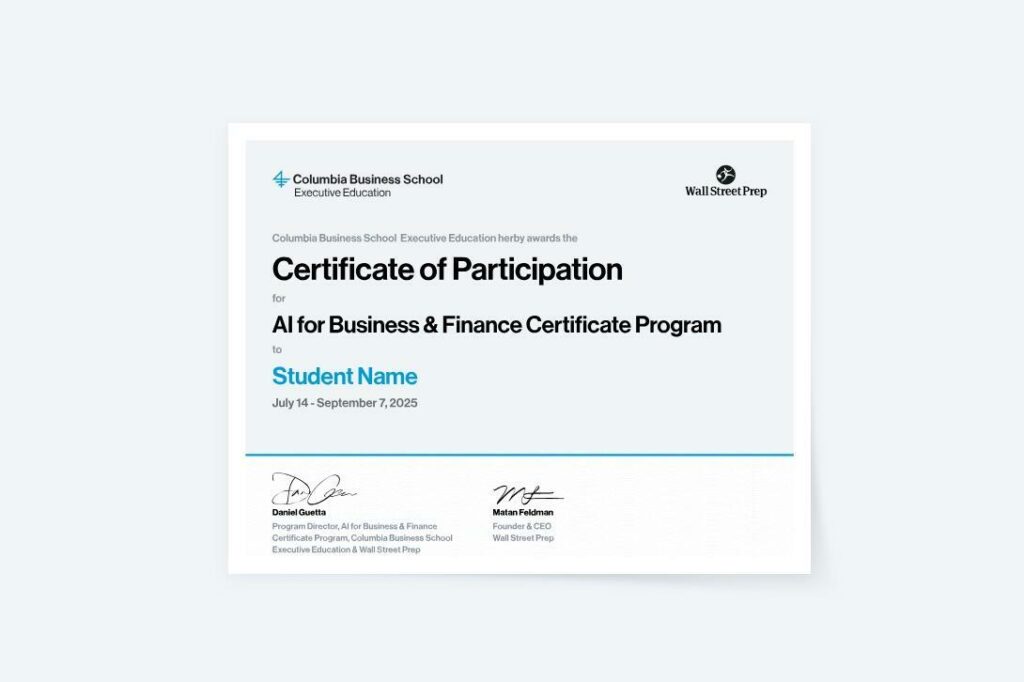
Columbia Business School’s Executive Education program, in collaboration with Wall Street Prep, provides a course that combines rigorous academic insights with practical financial instruction. The curriculum is designed for finance professionals and focuses on embedding AI tactics into financial processes, utilizing Columbia’s academic excellence and Wall Street Prep’s expertise in financial education. This combination makes it especially valuable for accountants trying to improve their skills in financial analysis and strategic decision-making using AI.
Accreditation & Recognition
Participants who finish the program will receive a diploma from Columbia Business School Executive Education. This certificate highlights the program’s emphasis on combining extensive business study with practical financial applications. It is a recognized testimonial to the participant’s capacity to incorporate AI into business and finance, stressing skills that go beyond theory and into practical knowledge.
Practical Applications and Learning Format
The course focuses on real-world applications of AI in finance. Participants acquire hands-on experience implementing AI-driven solutions via interactive case studies, live virtual sessions, and self-paced modules. The program also covers significant ethical and legal issues, ensuring a comprehensive grasp of AI’s role in financial systems.
Investment and Value Propositions
For financial professionals looking to progress their careers with advanced AI knowledge, this program provides a valuable opportunity to build relevant, actionable skills that fit with the industry’s increasing demands.
6. Introduction to AI for Accountants (edX):

The edX platform offers a course named Introduction to AI for Accountants, which is intended to provide accounting professionals with a basic knowledge of how AI is altering their field. This course is great for people who wish to learn about AI ideas without becoming bogged down in excessive technical jargon. It focuses on real-world applications, demonstrating how AI may improve accountants’ daily responsibilities.
Accreditation & Recognition
One of the course’s notable features is the ability to acquire a verified certificate upon completion. This certificate from edX can be linked to your LinkedIn profile, résumé, or other professional materials to highlight your accomplishment. To get the certificate, participants must complete assignments, meet passing criteria, and complete the course within the timeframe indicated.
Accounting’s practical applications
The training explains how AI tools may be effortlessly integrated into accounting procedures, streamlining operations and increasing productivity. Instead of focusing on theoretical elements, it gives professionals the capacity to identify places where automation might make their work more productive and time-efficient.
Flexibility and Learning Format
This course is designed as a self-paced program, making it simple for busy professionals to incorporate learning into their schedules. Enrolling in the verified certificate track provides participants with unrestricted access to instructional materials and videos for the life of the course, allowing them to review and reinforce their learning as needed.
Cost and Value for Money
While the precise price of this course is not specified, most edX validated certificate tracks are between $90 and $300. This makes it an affordable alternative for accountants wishing to gain a solid understanding of AI while also obtaining a significant certification to boost their professional credentials.
7. AI and Automation in Financial Services (FutureLearn):
FutureLearn’s AI and Automation in Financial Services course looks at how automation is changing the financial industry. While it is not specifically created for accountants, it does provide insights that are extremely useful for accounting professionals working in huge financial institutions. This course provides a solid basis for comprehending automation, followed by practical strategies that may be utilized in real-world circumstances.
Accounting’s practical applications
The training focuses on how AI-powered automation streamlines ordinary accounting processes. It delves into methods such as Robotic Process Automation (RPA) for data entry, machine learning for fraud detection, and automated reporting systems to improve financial statement preparation efficiency.
Case examples from top financial institutions bring these ideas to life. Participants learn how to categorize transactions using Natural Language Processing (NLP) and anticipate cash flow using predictive analytics, both of which are becoming increasingly important abilities for today’s accountants.
Flexibility and Learning Format
FutureLearn promotes a practical, community-based approach to learning. The course is designed as a social learning experience, allowing participants to interact with their peers via discussion boards while working at their own speed. It lasts many weeks, with flexible scheduling for accommodating busy professionals.
Each week focuses on a unique area of AI deployment in financial services, with video lectures, interactive exercises, and hands-on projects. Participants have access to digital resources and case studies that can be used immediately in their job. The time investment is modest, at around 3-4 hours each week.
Cost and Value for Money
A free version of the course allows you to access the majority of the content and community conversations. For individuals seeking additional benefits, an upgrade is offered for $49-$99, depending on the course length and institution.
The premium option provides benefits such as a certificate of completion, unlimited access to course materials, and the ability to submit assignments with comments. This low price, paired with its practical approach, makes the course an invaluable resource for accounting professionals negotiating the development of automation in their area.
8. Data Analytics and AI for Accountants (Coursera):
Coursera’s Data Analytics & AI for Accountants is a self-paced online curriculum intended exclusively for accountants who need to balance work and professional development. This course allows you to learn at your own pace, making it easier to integrate education into a busy schedule.
Flexibility and Learning Format
The course is available online via web and mobile platforms, allowing students to study whenever and wherever it is convenient for them. While the curriculum is designed to take roughly 10 hours of study each week for a suggested 3-month duration, many people finish in 5-7 months. It enhances core accounting abilities by incorporating data analytics and AI, preparing accountants to face the demands of a technology-driven market.
9. AI for Accountants Certificate (AICPA/CPA.com):
The AI for Accountants Certificate, developed by AICPA in collaboration with CPA.com, is designed to provide accounting professionals with practical AI skills. The emphasis is on applying AI to solve real-world accounting problems.
Accreditation & Recognition
This program is supported by the AICPA, one of the most prestigious organizations in the accounting profession. Designed to supplement ongoing professional education, the certificate is highly accepted by employers and demonstrates a commitment to remaining current with evolving accounting technologies. With this strong endorsement, attendees can be confident that the program is focused on providing practical and actionable knowledge.
Practical applications
The curriculum explores how AI may improve financial analysis, reduce repetitive operations, and aid in decision-making while adhering to US compliance rules. It also discusses how to apply AI solutions to accounting-specific difficulties. The curriculum also investigates ethical aspects and regulatory compliance, ensuring that participants are equipped to use AI appropriately in their jobs.
Flexible Learning Format
Recognizing the demands of a hectic working life, the curriculum is completely accessible online via CPA.com’s platform. Its self-paced framework allows participants to go through interactive content, hands-on training, and case studies at their own pace, making it simple to manage learning and work responsibilities.
Enhancing Career Opportunities
Enrolling in this program is a wise decision for accountants seeking to broaden their AI expertise and boost their careers. Participants who learn skills relevant to today’s technology-driven financial world position themselves as forward-thinking professionals prepared to prosper in an AI-influenced future.
Related Posts: Best AI Novel Writing Software
10. AI in Financial Reporting (Udemy):
Udemy’s AI in Financial Reporting course is designed for busy accounting professionals, giving you the freedom to fit studying into your schedule without affecting work or personal life. Whether you’re starting from scratch or revisiting concepts, the course allows you to work at your own pace, making it an ideal alternative for individuals with various obligations.
With unlimited access to all course content and compatibility with iOS and Android mobile apps, you may learn whenever and wherever it is most convenient for you. Whether you’re commuting, traveling, or just taking a break, the course allows you to review complex concepts and sharpen your skills.
The course features interactive aspects such as discussion boards, question and answer sections, video lectures, and hands-on tasks. These features adapt to various learning styles, making it easier to understand and apply concepts in real-world circumstances. This adaptable and interesting structure allows you to improve your accounting skills without interrupting your regular activities.
FAQ’s
Is artificial intelligence (AI) replacing finance and accounting jobs?
AI augments, rather than replaces, finance and accounting roles. Routine processes such as data input, basic reconciliation, bookkeeping, and report production are being automated. However, positions that require judgment, client relationships, strategy, and complex analysis are becoming increasingly important. Finance and accounting experts with an understanding of AI will supervise and assist these technologies rather than replace them.
How long does it take to learn AI courses for accountants?
Basic AI literacy for finance can be acquired in 10-15 hours via AI courses for accountants. Improving practical Python and data analytics abilities requires 4-6 weeks of constant study. Developing proficiency in machine learning applications for finance necessitates several months of experience with real data.
Which AI tools are most valuable to financial professionals?
The most useful AI tools for finance professionals are ChatGPT and Claude for analysis and report writing, Python with Pandas for data processing, and specific tools like Bloomberg Terminal’s AI features for market analysis.
Is Python required for AI courses for accountants?
Python is the most popular programming language in financial technology and artificial intelligence (AI). While Python is not required for basic AI tool usage (such as ChatGPT), it is necessary for specific data analysis, developing financial models, and dealing with machine learning.
How do I include AI talents in my finance resume?
Complete AI courses for accountants, obtain valid credentials, and include them in your education section. More significantly, mention AI-related achievements in your experience: “Implemented AI-powered forecasting that improved accuracy by 20%” is more powerful than “Completed AI courses for accountants.”
Conclusion
AI’s rapid growth is altering the accounting sector, and we must remain competitive in the face of technological change. Earning AI certification and pursuing AI courses for accountants can help you develop the abilities you need to succeed. Whatever your AI interests are (e.g., automation, data science, strategic applications), the best AI courses for accountants have something for everyone.