








From onboarding and compliance to continuous professional development, AI is revolutionizing the way we learn at work. AI-powered learning management systems (LMS) or AI learning platforms are helping businesses and organizations rethink how they provide training.
Data and automation are used by an AI-powered LMS to identify skill gaps, personalize content, and expedite administrative tasks. The outcome is a quicker, more pertinent learning process that boosts productivity, performance, employee engagement, and organizational advancement.
Organizations can automate course delivery, streamline employee training, and customize learning experiences with intelligent insights by implementing AI learning platforms. Tracking learner progress, sustaining engagement, and coordinating training with business objectives can easily become unmanageable without the proper platform.
This article thoroughly reviews each AI learning platform, with an emphasis on its AI features, advantages, and potential drawbacks. Let’s examine how these options can meet your team’s specific requirements.
Table of Contents
What is an AI-powered learning platform?
An online training system that employs artificial intelligence (AI) technologies, such as machine learning (ML) and natural language processing (NLP), to customize and improve the learning process is known as an AI learning platform. By using data and algorithms to make intelligent, real-time decisions that promote each learner’s development, these AI learning platforms go beyond conventional learning management systems (LMS).
A learner’s behavior, performance, and preferences are analyzed by the AI learning platforms to provide training materials, tests, and learning paths that are customized to meet their individual needs. To keep students on track, this may entail determining knowledge gaps, modifying the training materials’ level of difficulty, or suggesting next steps.
AI learning platforms provide a dynamic and adaptable learning environment rather than a one-size-fits-all method. Whether in a corporate, academic, or professional development setting, they help people learn more efficiently, retain more information, and perform better.
An example of AI-driven learning in action
Consider the scenario: an employee completes a number of compliance training modules using AI learning platforms. When an employee encounters issues with data privacy, the platform suggests a coaching session, a refresher micro-course on data handling, or a brief video that delves deeper into the subject.
In addition, AI learning platforms identify the employee’s proficiency in cybersecurity fundamentals and suggest more complex content to maintain the employee’s interest in the subject.
AI and data-driven adaptive learning that is prepared for your strategic goals is best suited for research and development teams.
What is adaptive learning?
Adaptive learning is a customized approach to education that makes use of technology to adjust the learning experiences to each student’s preferences, pace, prior knowledge, strengths, and weaknesses. AI learning platforms go beyond static course delivery by using adaptive learning to direct students along a customized path that is created for them based on their behavior.
AI learning platforms customize the way content is presented using algorithms and other AI tools, creating a learning experience that varies depending on how each user engages with the content.
How it operates:
You can apply a skills taxonomy and track learner performance at scale with AI learning platforms. Let’s see what it looks like:
- Data collection from the learner: The learner begins a course by taking a short assessment. Based on their performance, AI learning platforms suggest the appropriate level of tasks, learning activities, and resources.
- Adapting to the learner’s data: If the learner struggles in a particular area, the AI learning platforms slow down, provide additional explanations, or recommend specific content. If they excel, the AI learning platforms speed up their progress or introduce more advanced material.
- Continuous monitoring of the learner’s competencies: Because all assessments, activities, and learning materials are hosted within the LMS, the AI learning platforms constantly track progress. As the learner’s engagement increases, the AI learning platforms collect more data and make more appropriate recommendations, provide more immediate feedback, and suggest targeted resources.
Finally, adaptive learning ensures that no two learners take the same path. Instead, they all choose paths based on their individual needs. This reduces knowledge gaps, increases retention, and helps each learner achieve meaningful outcomes.
However, for most teams, ambition and execution remain misaligned. According to Absorb’s AI in Learning report, 25% of the research and development teams prioritize personalization over business performance, with less than 4% prioritizing the latter. Executives are looking for ROI, and research and development teams are optimizing for learner experience. The next step in the evolution of AI learning platforms is to link adaptive, personalized learning directly to measurable business outcomes.
Related Posts: Best AI Courses for Software Engineers
How is an AI-based LMS different from a traditional LMS?
Traditional learning management systems (LMS) are effective at delivering content and tracking completion rates. They struggle with their reliance on static, one-size-fits-all course structures. Every learner takes the same path, regardless of prior knowledge, learning style, or performance.
AI learning platforms add flexibility and customization to the process. It uses machine learning and data analysis to tailor the learning experience to each user’s interactions with the platform.
Here’s the main difference:
- Traditional LMS: Designed to manage learning content and track progress. Everyone sees the same materials in the same sequence.
- AI-based LMS: Algorithms are used to personalize content, recommend next steps, identify knowledge gaps, and optimize outcomes for each individual learner.
The most effective AI learning platforms go beyond personalization. They link learning activities to outcomes that the business already monitors.
What are the benefits of an AI-based LMS?
AI learning platforms are more than just smarter technology; they provide real, measurable benefits to learners and organizations. These AI learning platforms use data to shape the learning experience, allowing people to learn faster, retain more information, and feel more supported throughout their journey.
Here are some key advantages:
1. Personalized learning paths:
No two learners are the same, and AI learning platforms reflect this. It creates personalized learning journeys for each user based on their performance, goals, and preferences. That translates to more relevant content, fewer wasted hours, and better outcomes. Learners concentrate on the topics that require more instruction and can quickly move through (or completely skip) those that they already understand thoroughly.
2. Faster skill development:
AI learning platforms can speed up the learning process by identifying and addressing knowledge gaps. Learners are not required to repeat what they already know or sift through irrelevant content, such as topics unrelated to their role or position.
3. Smarter assessments and feedback:
Instead of simply grading quizzes, AI learning platforms interpret the data underlying the answers. It can identify patterns of misunderstanding, suggest review materials, and provide real-time feedback to help the learner in the moment.
4. Improved engagement and retention:
Learners are more likely to remain motivated when the content is relevant and attainable. Adaptive recommendations, gamification, and intelligent reminders help learners progress and complete their training.
5. Actionable insights:
Administrators and instructors have access to powerful analytics on these AI learning platforms that show them who is struggling, who is succeeding, what content works best, and where students are falling behind. This allows for more informed decision-making throughout the organization.
6. Cost-effectiveness:
Your company can save money, time, and effort with automation, improved learning, and modern data analytics.
7. Scalability:
An LMS powered by Al can grow without sacrificing quality. Automation results in less administrative time, less manual tracking, and a greater emphasis on support.
What are some essential components of AI learning platforms?
AI learning platforms are loaded with features that are intended to improve results, expedite administration, and customize the learning process. The following are some of the most crucial characteristics to look for:
- Adaptive learning experiences: Depending on the learner’s performance, engagement, and preferences, AI learning platforms modify the content delivery. As a result, learning becomes more individualized and focused, and the one-size-fits-all training is over.
- Intelligent content recommendations: Based on the learner’s performance and what they have finished, the AI learning platforms recommend the next best module, video, article, or activity. This keeps students focused and involved in the process.
- Real-time feedback and intelligent evaluations: AI learning platforms examine how students react to interactive exercises, simulations, and tests. When it finds misconceptions or areas for development, it provides immediate feedback and recommends more resources.
- Predictive analytics: AI learning platforms show administrators useful information like learner behavior trends, anticipated performance outcomes, and the efficacy of content. Over time, these insights enhance training initiatives.
- Natural language processing (NLP): Some AI learning platforms use NLP to enhance personalization and responsiveness by powering chatbots, facilitating conversational learning, or analyzing learners’ written input.
- Learner segmentation: Instructors can more effectively customize communications, feedback, and interventions by using AI learning platforms to group students according to skill level, progress, goals, or even engagement patterns.
- Multimodal learning support: Depending on how a user learns best, a variety of AI learning platforms can suggest different kinds of content, including text, audio, video, and simulations. This increases the AI learning platforms accessibility and inclusivity.
What types of learning are best suited for AI learning platforms?
Although they aren’t always appropriate, AI learning platforms are especially well-suited for some kinds of training. You can select the best tool for your needs by knowing where they work best and where a traditional model will work better.
Best suited for AI learning platforms
- Skill-based training: Technical skills, software training, and compliance modules are examples of skills-based training. AI can swiftly detect knowledge gaps and modify the content to fill them.
- Continuous learning and professional development: AI learning platforms are excellent for companies that prioritize lifelong learning because they can design dynamic learning paths. The AI learning platform’s comprehension of users’ needs changes as they do.
- Test preparation and certification training: Adaptive learning concentrates study time where it is most needed when students are working toward a specific goal, like passing a certification exam.
- Self-paced, independent learning: AI learning platforms offer flexible pathways, just-in-time support, and personalized recommendations for learners who would rather go at their own speed.
- Large-scale or worldwide training: AI learning platforms customize delivery for various languages, time zones, and learning styles while standardizing learning quality across regions.
Related Posts: Best Artificial Intelligence Free Courses With Certificates
Best suited for traditional LMS models
- Instructor-led or workshop-style training: A traditional LMS combined with scheduled instruction might be more suitable when the objective is to promote discussion, peer learning, or cooperative problem-solving.
- Conceptual or theoretical learning: Human facilitation may be more beneficial than algorithm-driven pacing for subjects like ethics, philosophy, or strategic leadership that call for in-depth discussion, open-ended inquiry, critical thinking, or subjective learning.
- Niche or custom workflows: It may be more difficult to use AI to optimize highly specialized training that is difficult to break down into data-driven pathways.
Best AI Learning Platforms
1. Docebo:
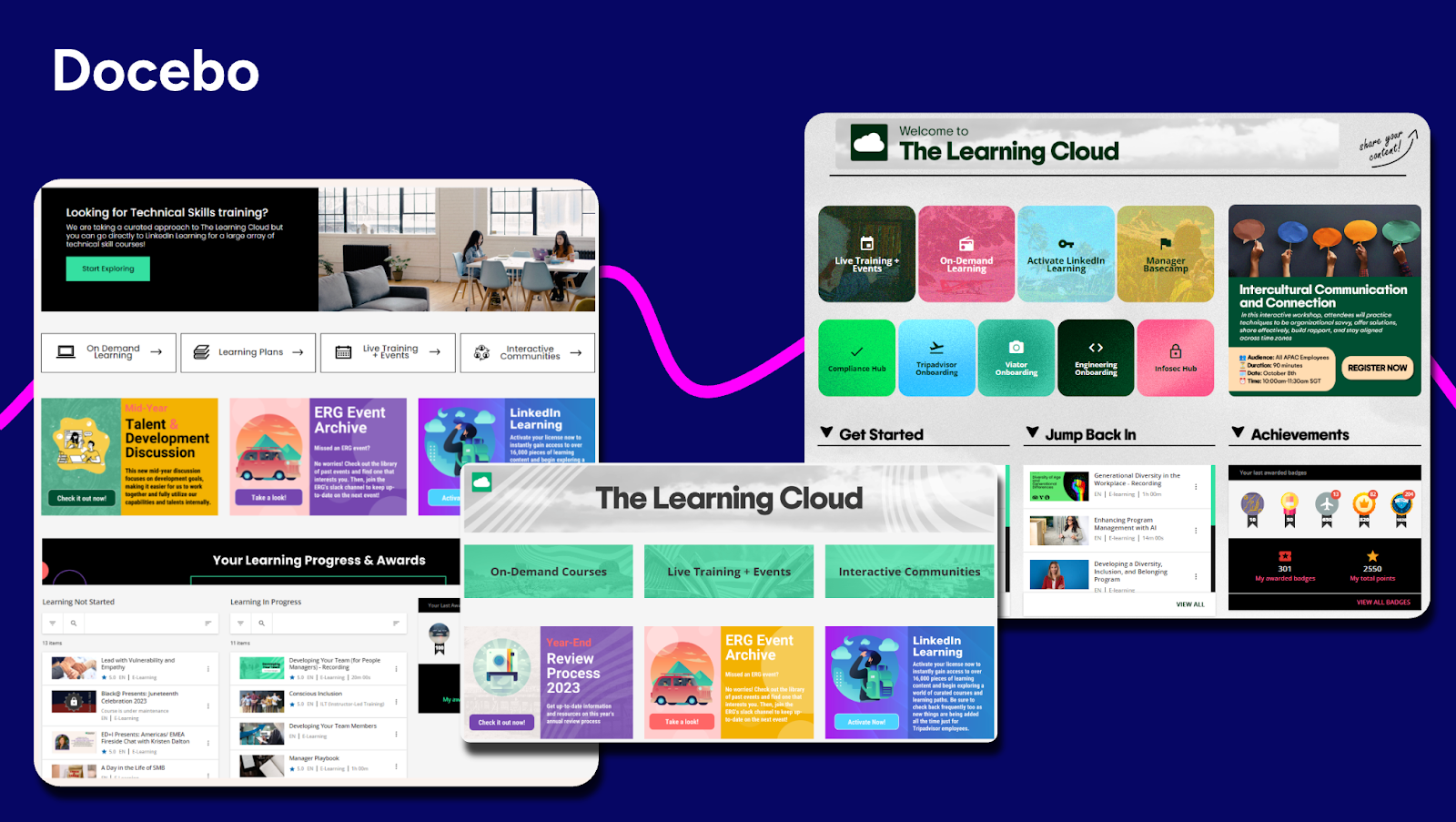
Designed for businesses looking for unparalleled scalability and hyperpersonalized, data-driven, adaptive learning, Docebo is a top AI learning platform with both LMS and learning experience platform (LXP) functionalities.
Docebo offers gamification and engaging social learning features, seamless administrative task automation, strong API and webhook-based integrations, and robust reporting and data analytics to help you connect your learning objectives with business goals. Most significantly, Docebo uses strong AI capabilities to improve learner engagement while streamlining learning management.
Key AI features
- Harmony Search (AI Chat): Chat-based natural language content exploration with straightforward responses
- Creator (AI Content Generation): Training materials with AI-generated content, tests, and AI avatar video presenters are quickly created and translated.
- Auto Tagging and Skill Assignment: Enhanced discoverability through automated skill mapping and content classification
- AI worldwide search: Uses keywords to prioritize and display pertinent content
- Personalized Content Suggestions: AI-driven recommendations for administrators, managers, and students
2. 360Learning:
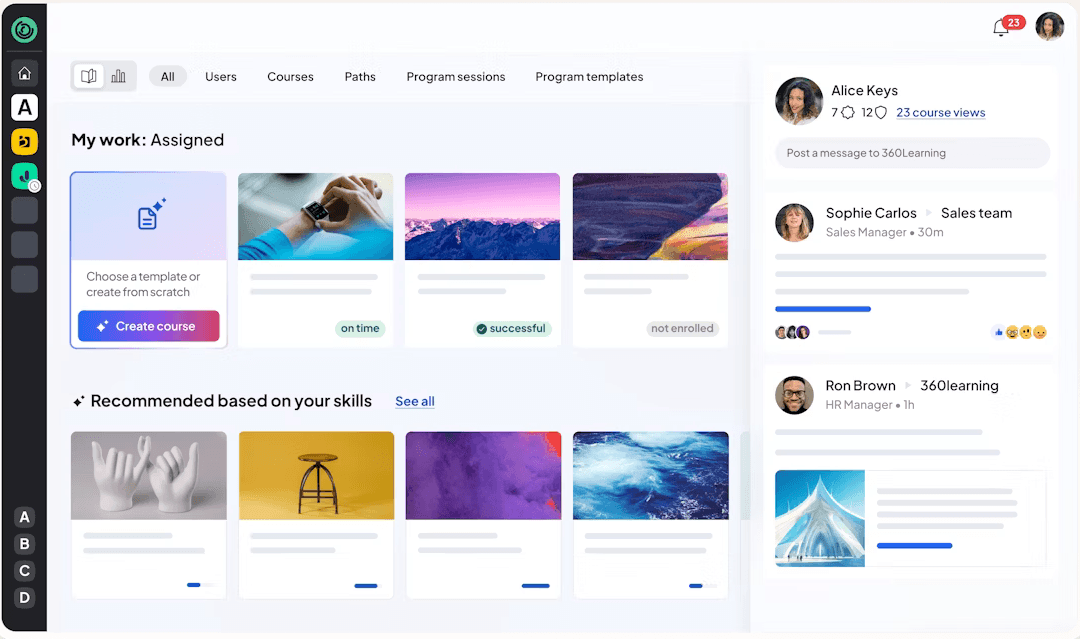
360Learning is a cloud-based, AI-powered learning management system (LMS) that combines traditional learning with social learning features to address reskilling and upskilling. It is well-known for its collaborative learning approach. The platform also has a number of contemporary LMS features, such as reporting and analytics to monitor engagement, completion, and business impact, as well as integrations with popular tools like Salesforce, Workday, and Zoom.
Key AI features:
- AI-driven course builder with intelligent question recommendations and automated content creation
- AI suggestions based on the abilities and conduct of employees
- Automated catalog skills-tagging combined with skills-based learning
3. Sana Labs (acquired by Workday):
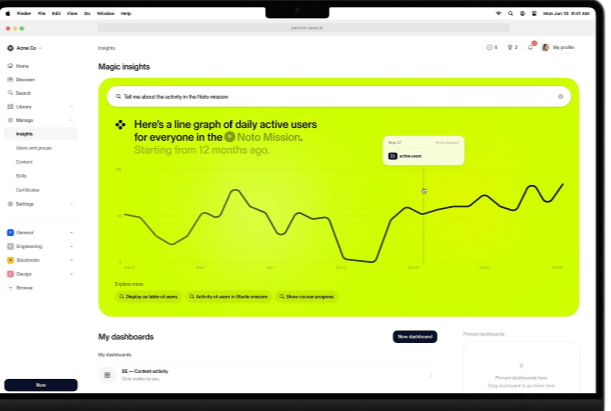
Sana is a state-of-the-art AI learning platform created to address knowledge management and learning, primarily for internal training use cases such as employee development and onboarding. Sana Labs offers an AI-native learning platform that combines authoring tools, virtual classroom capabilities, LMS, and LXP into a single, all-inclusive solution.
The platform caters to enterprises and small businesses alike that are looking for scalable, customized learning experiences that adjust to each person’s performance and learning style. Sana Labs incorporates artificial intelligence from the ground up into its core architecture, in contrast to conventional learning platforms that add AI features on top.
Key AI Features:
- 1:1 Learning Experience: Based on individual performance data, each learner receives individualized tutor-like experiences.
- Instant search capabilities and AI-powered responses in natural language with source citations are provided by just-in-time learning.
- Collaborative Authoring: Facilitates the quick production of interactive content with support for multi-creator collaboration
- AI-Powered Analytics: Produces shareable dashboards with automated performance analysis and real-time insights
- Agentic AI: Agents integrate with other platforms, such as Salesforce, and conduct in-depth searches
- Skills management uses real-time performance data to create adaptive learning experiences and track student progress.
4. Absorb LMS:
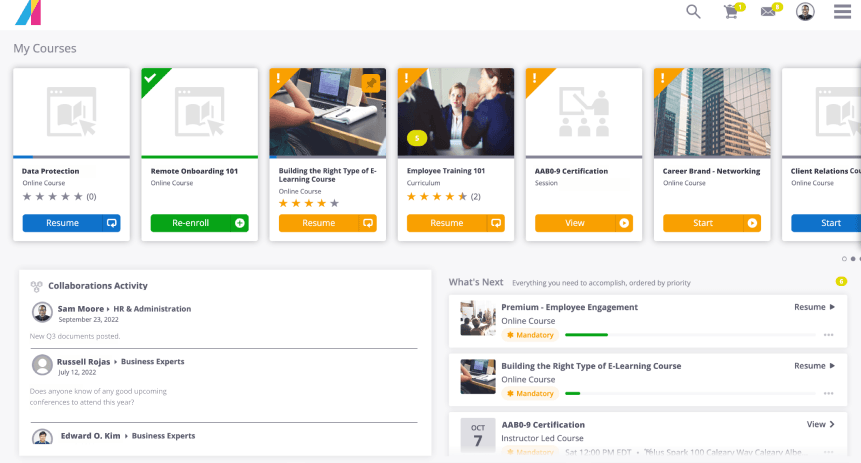
Absorb LMS is an AI-powered cloud-based learning management system that helps businesses customize learning for a range of use cases. This learning solution is ideal for companies looking to scale their training programs effectively because it improves learner engagement and administrative efficiency through intelligent automation and personalization features.
Key AI Features:
- Intelligent Course Creation (Create AI): Researches, organizes, and designs courses with interactive components like animations, videos, and tests using generative AI.
- Intelligent Admin Support (Intelligent Assist): An AI-driven tool that instantly retrieves reports and action screens by processing natural language requests
- Intelligent Personalized Upskilling (Absorb Skills): Using Absorb Skills to identify skills gaps and make wise course recommendations
- Intelligent Ranking and Recommendations (Absorb Adapts): AI prioritizes pertinent content by ranking search results according to learner behavior.
- Intelligent Quiz Creation: Produces excellent, course-related quiz questions automatically to support learning
- Intelligent Assist AI Tool: Using AI to report insights for predictive analytics
5. SC Training:
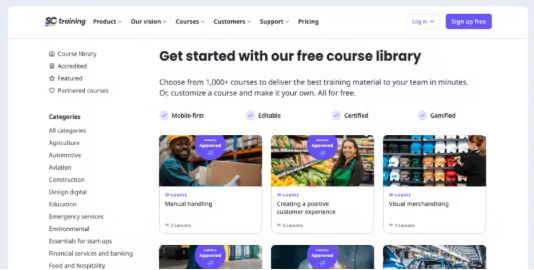
Bite-sized, on-the-go learning is the focus of SC Training (formerly EdApp), a mobile-first LMS. It helps businesses deliver quick, interesting microlearning straight to smartphones and is designed for teams that don’t sit behind desks.
Key AI Features:
- Creator tool: Using pre-existing content or prompts, the creator tool creates interactive microlearning lessons and tests.
- AI Translation: Supports international frontline teams by instantly translating courses into several languages.
- AI text-to-speech narration: Transcribes audio files used for course narration
6. iSpring Learn:
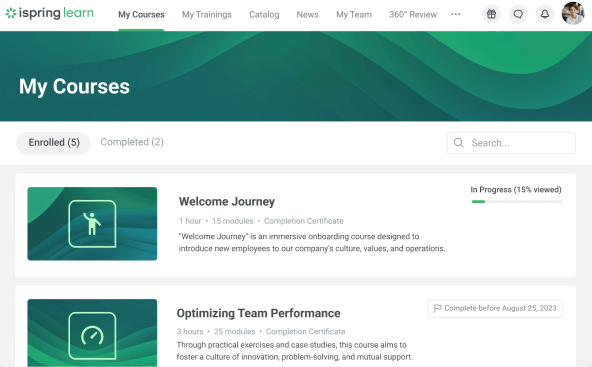
A cloud-based learning management system called iSpring Learn was created for companies in need of an easy-to-use corporate training and e-learning platform. It works particularly well for teams or small to medium-sized businesses that lack the time or resources to manage intricate learning ecosystems. Additionally, the platform has automated workflows that relieve administrators of manual tasks by tracking learner progress, assigning training, and sending reminders.
Key AI Features:
- iSpring AI: Use AI to develop courses, produce content, and create assessments
- AI chatbot: The platform’s quick and simple tech support
- AI assistant: iSpring AI support tool to expedite the conversion of learning objectives into excellent courses
Related Posts: Learn AI: Best AI Courses for Beginners
7. Cornerstone:
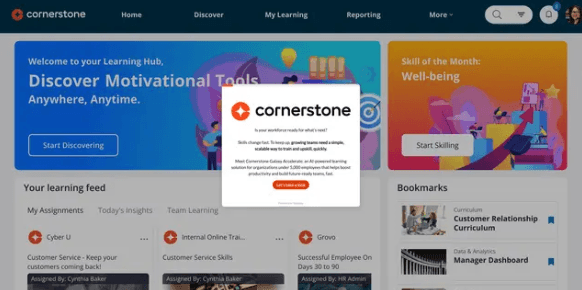
The Cornerstone LMS, which focuses on corporate training, uses automations, personalized learning paths, and a centralized content hub to help organizations manage, deliver, and monitor training programs. Its robust analytics provide L&D teams with insight into performance and skill gaps, and its AI-powered recommendations help match learning with individual career goals. Cornerstone is perfect for big businesses and supports end-to-end talent development by integrating with more comprehensive HR systems.
Key AI Features:
- AI-powered customized learning pathways: arranges necessary courses in the proper sequence
- AI-driven job matching: Enhances internal mobility and hiring
- AI Skills Transformation: Identifies gaps by mapping job roles to skills
- AI Text Generation: Produces original educational content based on a straightforward prompt
8. CYPHER Learning:
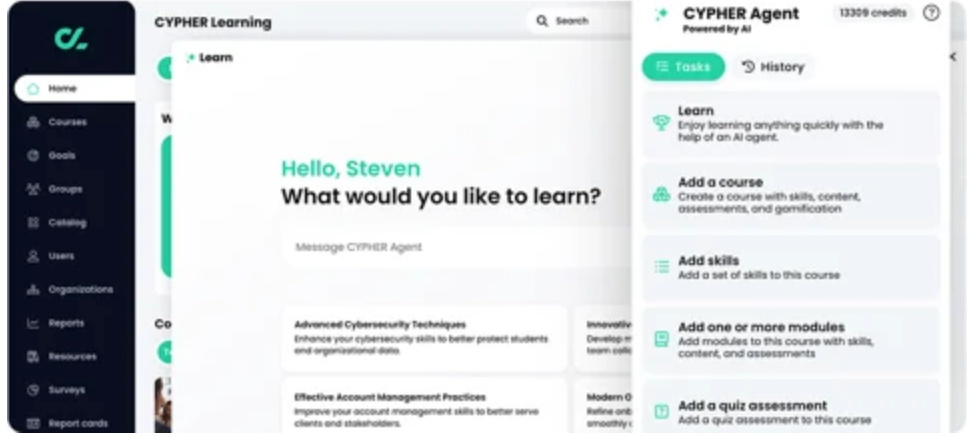
CIPHER Learning is an AI-powered learning management system designed for startups, businesses, and academic institutions that supports a variety of use cases, including partner enablement, corporate learning, and customer education.
Key AI Features:
- CIPHER Agent: A genAI tool that allows learners and administrators to customize learning and produce content, respectively
- AI Skills Mapping: Automatically detects skill gaps and suggests tailored learning paths to fill them.
- AI-generated gamification and assessments: GenAI creates educational games and knowledge tests.
9. Talent LMS:
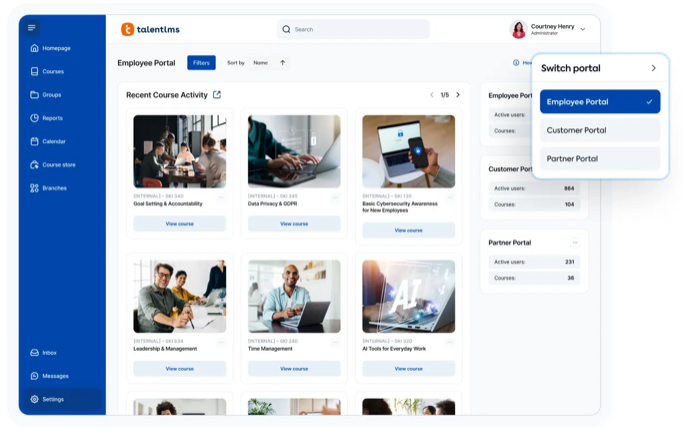
TalentLMS is a cloud-based LMS designed with speed and ease of use in mind. TalentLMS has started adding intelligent features to help organizations automate repetitive tasks and personalize learning, even though it does not market itself as an AI-first platform.
Key AI Features:
- AI Content Creator: Produces learning resources and course outlines to assist administrators in creating content more quickly.
- AI Test Creator: Produces tests and tests according to content creators
- AI Translator: Converts instructional materials into more than 40 languages
- Content Companion: AI-powered, customized recommendations of pertinent content are given to students.
- AI Coach: An integrated content coach that assists students with knowledge checks and practice questions
10. LearnUpon:
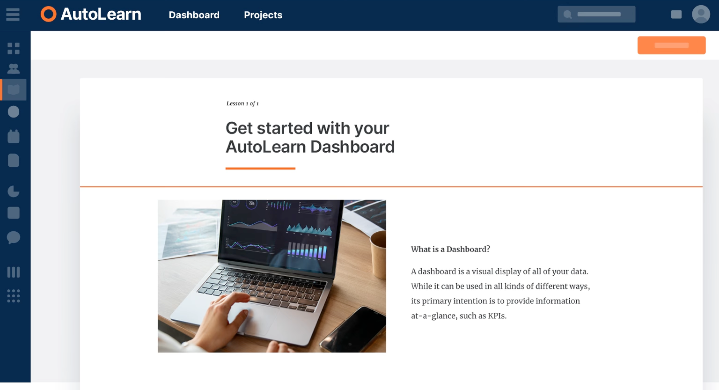
LearnUpon is a cloud-based learning management system that supports a variety of use cases, including partner enablement, customer education, and employee onboarding. The system streamlines the entire learning process by combining intelligent recommendations, automated assessments, and generative AI tools for quick course development.
LearnUpon, which is well-known for its user-friendly course builder, has an AI-powered assessment tool that simplifies the evaluation of training materials.
Key AI Features:
- AI-powered content generation for course authoring: Produce course materials quickly with AI-generated summaries, tests, and multimedia additions.
- AI-powered personalized learning pathways: Based on the learner’s role, behavior, and skill objectives, they automatically suggest pertinent courses.
- AI coach: An interactive, intelligent coach that encourages students to think critically, pose questions, and remain interested in the material
- AI-generated course and module summaries: These summaries highlight important lessons to help students review and reinforce what they have learned.
Conclusion
Adopting AI means radically altering how you cultivate talent and produce outcomes, not just upgrading your software. You can transition from static course catalogs to a dynamic learning ecosystem that provides intelligent insights and individualized experiences. This is about unlocking you and your team’s potential to learn and adapt at the speed of business, not just about efficiency.
FAQs
What is the data privacy policy of AI learning platforms?
Yes, by using encryption and access controls, AI learning platforms usually put data privacy first. To safeguard user data, they abide by laws like GDPR. Make sure the system you select has robust privacy policies and procedures in place. To preserve compliance and trust, look for features like data anonymization and frequent security audits.
Can current HR tools be integrated with AI learning platforms?
Integrations with well-known HR tools like payroll and performance management systems are available for the majority of AI learning management systems. This enables you to establish a smooth workflow between other HR tasks and training. To guarantee a seamless integration process, check the system’s compatibility with your current software and think about utilizing APIs for unique connections.
In what ways can AI improve these systems’ learning process?
By anticipating learner needs, automating administrative tasks, and personalizing content, AI learning platforms can improve the educational experience. AI, for example, can recommend courses based on learning history or skill gaps. Additionally, it can offer analytics to help you comprehend learner engagement and progress, enabling you to successfully customize your training programs.
Can small businesses use AI learning platforms?
Yes, small businesses, particularly those with scalable pricing models, can benefit from AI learning platforms. They offer resources for effectively managing training without a big team. Search for systems with adaptable plans and user-friendly features so you can deploy them without requiring a lot of technical assistance.
How can I calculate an AI learning platform’s return on investment?
Metrics like improved employee performance, reduced training administration time, and higher learner engagement can be used to gauge the return on investment. To determine value, compare these to the system’s cost. Utilize the AI learning platforms analytics to collect information and create reports that demonstrate how the training affects your company’s results.