








Professionals with knowledge in AI engineering are in high demand as artificial intelligence has emerged as one of the most sought-after sectors in technology, spurring innovation across industries. For engineers, developers, and leaders in technology who wish to acquire the technical know-how, strategic insights, and practical experience necessary to successfully build, execute, and scale AI systems, selecting the best AI courses for software engineers is an essential first step.
In addition to covering machine learning, deep learning, and generative AI, these AI courses for software engineers also examine how AI interacts with corporate strategy, ethical frameworks, and enterprise systems. These AI courses for software engineers are offered by prestigious universities like MIT, Wharton, and Carnegie Mellon, they offer the technical depth and leadership preparedness required in today’s AI-driven economy.
These AI courses for software engineers can help you develop the abilities and self-assurance to lead in this revolutionary field, whether you’re an engineering professional looking to expand your technical knowledge or a senior leader aiming to match AI with organizational objectives. You can put yourself at the forefront of AI innovation and have a significant impact on business and technology by signing up for one of these AI courses for software engineers.
Table of Contents
What is an AI Certification?
AI courses for software engineers are organized educational programs created by esteemed universities that convert theoretical knowledge into practical, proven skills, providing companies with tangible proof of your ability to effectively use AI solutions in real-world contexts.
AI certifications generally include the following elements:
- Practical projects with authentic datasets
- Training in industry-standard artificial intelligence frameworks and technologies
- Evaluation of your capacity to address AI-related difficulties
- Acknowledgment from respected technology leaders or academic institutes
The true distinguishing factor of outstanding AI certificates is their emphasis on practical application. The most effective AI courses for software engineers not only impart theoretical knowledge but also facilitate the creation of functional AI solutions, clarify model deployment, and address existing obstacles in AI development.
AI courses for software engineers serve as formal approaches into the discipline. They offer a curriculum that methodically enhances your knowledge, which is especially helpful due to the rapid evolution of AI technology.
Criteria for Choosing Relevant AI Courses for Software Engineers
Selecting the appropriate AI certification involves more than only opting for the most renowned AI courses for software engineers or those associated with one of the biggest brands. Your selection should align with your professional objectives, existing skill set, and the particular AI technologies relevant to your current or ideal career.
Take into account the following factors:
- Your technical foundation: Certain AI courses for software engineers assume extensive experience of statistics and programming, whereas others begin with fundamental concepts. Verify the qualifications to ensure you are positioning yourself for success.
- Investment of time and resources: Certification expenses range from several hundred to several thousand dollars, with time commitments spanning from weeks to months. Assess the financial and temporal demands in relation to your present circumstances.
- Industry acknowledgment: Investigate which AI courses for software engineers are well respected in your desired industry or position. Talk with employers regarding their expectations. Cloud platform certifications such as AWS and Azure usually possess greater significance in corporate settings, but academic qualifications may be more valued in research positions.
- Career trajectory: Consider your desired position in 2-3 years. Are you pursuing a specialized profession as an AI engineer, or do you require AI expertise to enhance your existing position?
AI Certificates for Beginners Vs Skilled Professionals
AI certifications are not just for beginners or undergraduate students. AI courses for software engineers are available for nearly every stage of a career, whether one is a software developer or a data analyst; no AI courses for software engineers are permanent.
Several occupations start with a fundamental qualification and subsequently earn specialized certifications as their careers advance. Selecting an entry point point that aligns with your existing talents while advancing your career objectives is important.
For beginner learners:
- Begin with fundamental programs such as IBM’s AI Engineering Professional Certificate or Google’s Machine Learning Crash Course.
- Concentrate on certificates that impart practical applications without demanding significant mathematics.
- Consider AI courses for software engineers that incorporate practical projects accompanied by supervised training.
- Consider AI courses for software engineers that cover foundational AI concepts and progressively advance to more intricate subjects.
For skilled learners:
- Pursue specialist certifications such as Stanford’s AI Graduate Certificate or NVIDIA’s Deep Learning Institute programs.
- Concentrate on credentials that correspond with your particular domain of competence (computer vision, NLP, etc.).
- Consider AI courses for software engineers that prioritize innovative methodologies and research.
- Explore AI courses for software engineers that incorporate advanced projects and practical implementation challenges.
Reasons Why Software Engineers Must Have AI Skills
One of the most significant technological shifts since the Internet’s inception is likely to be the incorporation of AI into software development. Having knowledge of artificial intelligence is now essential for software engineers. In addition to improving your problem-solving and productivity skills, these abilities also make it easier for you to incorporate AI into your projects. Envision yourself able to automate routine jobs, optimize solutions, and build smarter apps that can learn and change as you use them. This is the strength of software engineering and AI courses for software engineers.
Gaining proficiency in AI also sets you up for future technological advancements, which is crucial for keeping up with a dynamic industry. You can become an important asset to any development team by learning to use AI technologies effectively. Your creativity and problem-solving talents will be considerably enhanced. However, when it comes to addressing complicated problems, considering ethical implications, and coming up with novel solutions, human input is still crucial, even though AI can automate many tasks.
Software engineers must have a firm grasp on the moral dimensions of artificial intelligence. They need to make sure that these technologies are used ethically and responsibly as AI becomes more embedded into the projects. For this, you need to be aware of the possible biases and ethical challenges, and you also need to know how to handle them.
Related Posts: 11 Best Ai Vocal Remover
Jobs in Artificial Intelligence: A Shift from Software Engineering
A large number of positions are anticipated to be filled in a variety of sectors as a result of the integration of AI into software engineering. In order to take on more responsibility and keep up with the ever-changing technology industry, software engineers who are making the jump to artificial intelligence (AI) must get training in AI tools and technologies.
Learning machine learning AI courses for software engineers, such as algorithms, data science, and real-world AI applications, is an important part of upskilling in artificial intelligence. This change will be easier with the help of AI courses for software engineers from DeepLearning.AI and Microsoft, which can give the groundwork and advanced understanding that is required. In addition, working on real-world AI projects and gaining practical experience can greatly improve your preparedness for careers that revolve around AI.
Having these particular competencies will make you stand out from the competition for AI engineer jobs, which are in high demand. You can keep up with the competition and be ready for future prospects in AI by embracing developing technology and keeping up with industry trends.
Practical AI Tasks for Software Engineers
Software engineers can put their AI skills to use and obtain practical experience by participating in AI initiatives. For people who are hard of hearing, projects like developing a computer vision-based sign language recognition app can open up new avenues of communication. By detecting and fixing spelling errors, an autocorrect tool developed with natural language processing can improve text input experiences.
In addition, there are ongoing efforts such as creating a system to detect false news stories using pre-trained models such as BERT and creating an object identification system to find things in images using datasets such as Kaggle’s Open Images. Your marketability as an AI job applicant will increase thanks to these initiatives, which will help you hone your technical abilities while exposing you to practical AI applications like model training and deployment.
Python-based artificial intelligence (AI) applications, such as machine learning and interactive projects, are the subject of Harvard University’s CS50 course. Students can gain valuable knowledge in memory management and agent building with the LangChain course, which also allows them to build applications with massive language models. If you want to show off your abilities to prospective employers and get some real-world experience, these kinds of initiatives are a must.
Best AI Courses for Software Engineers
To assist you in finding the most appropriate AI courses for software engineers, we have compiled a list of the best AI courses offered by universities, businesses, and trade groups. A diverse set of AI skills covering a wide range of topics can be achieved by pursuing any or all of these AI courses for software engineers.
These AI courses for software engineers can help you handle practical technical problems and stand out in a competitive job market, whether you’re wanting to improve your model development skills or master deployment workflows:
1. Stanford University AI Graduate Certificate:
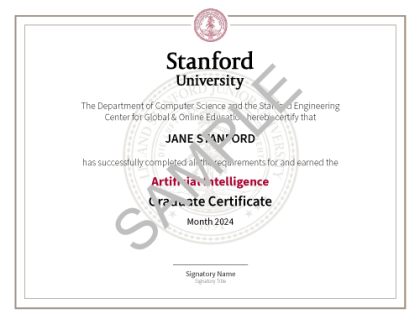
The rigorous academics and extensive curriculum of Stanford University’s AI Graduate Certificate have earned it a stellar reputation as one of the top AI research programs in the world. The program explores the theoretical underpinnings of AI in depth while keeping a significant emphasis on practical applications through projects that students work on their hands.
Renowned professors teach a wide range of AI topics in this comprehensive AI courses for software engineers, which covers everything from logic and probabilistic models to NLP and robotics.
- Topics covered include: Knowledge representation, NLP, robotics, machine learning, and foundational AI principles.
- Cost: About $20,000 for the complete program
- Duration: 2–3 years, part-time
- Difficulty: High; proficiency in mathematics and computer science is essential.
- Academic Accreditation: Stanford University School of Engineering academically accredited
2. DataCamp’s AI Fundamentals Certification:
Without getting too lost in the technical details, DataCamp’s training teaches the basics of artificial intelligence. If you’re a professional who needs to know how AI will affect your company, this AI courses for software engineers is for you. It goes over the fundamentals as well as more advanced subjects like generative AI and ChatGPT. In addition, compared to more theoretical approaches, their hands-on learning method makes concepts stick.
- Topics covered include: artificial intelligence basics, generative AI, LLMs, and real-world business uses of AI.
- Cost: Part of DataCamp Premium ($25/month) membership
- Duration: Approximately ten hours of main material
- Difficulty: Easy to moderate, no coding skills needed
- Accreditation: DataCamp certification, recognized by the data science community.
3. Deep Learning Specialization by Andrew Ng:
If you were to ask any AI professional about their educational background, Andrew Ng’s Deep Learning Specialization would probably be mentioned. That’s for a good reason: Ng possesses an exceptional ability to simplify otherwise incomprehensible ideas in deep learning. What makes this curriculum unique is Ng’s ability to relate theoretical ideas to practical applications; the course covers everything from the fundamentals of neural networks to the most recent architectures.
- Topic covered include: Convolutional neural networks (CNNs), recurrent neural networks (RNNs), and transformers
- Cost: Coursera charges $59 per month.
- Duration: Four to five months at a pace of ten hours per week
- Difficulty: Intermediate level, requiring basic Python and linear algebra.
- Certification: Well-respected industry credential from Coursera’s specialized program
4. NVIDIA Deep Learning Institute Certification:
You should prioritize NVIDIA’s certification program if you are truly committed to deep learning, particularly in computer vision and GPU optimization. This AI courses for software engineers delves into the details of deep learning and accelerated computing, and it comes from the same business that powers much of the world’s AI gear. Practical, hands-on laboratories utilizing real-world datasets are the main focus. Learn the most recent and cutting-edge approaches as NVIDIA regularly updates the curriculum to reflect their latest hardware and software developments.
- Topic covered include: Computer vision, deep learning, GPU-accelerated computation, and model optimization.
- Cost: Program prices vary from $30 to $500.
- Duration: A range of classes, usually 8-20 hours each
- Difficulty: Intermediate to Advanced; Prior knowledge of computer programming is necessary.
- Certification: NVIDIA DLI, widely acknowledged in the industry
Related Posts: Best AI Meeting Assistant
5. Google Professional Machine Learning Engineer:
The Professional Machine Learning Engineer credential from Google has an emphasis on developing and implementing large-scale ML systems that are suitable for production. Earning this credential shows that you can formulate ML challenges, design ML solutions, and apply MLOps techniques in the actual world. Organizations developing cloud-based AI solutions will find it useful because it highlights GCP-based end-to-end machine learning pipelines.
- Topics covered include: Machine learning systems for production, MLOps, data pipeline design, and GCP model deployment
- Price: $200 (including exam and study materials)
- Duration: Usually three to six months at a self-paced pace
- Difficulty: Advanced Level; Must have a firm grasp of machine learning principles and Python code.
- Accreditation: Valid for 2 years, recognized worldwide Google Cloud certification
6. Microsoft Azure AI Engineer Associate:
Certification as an Azure AI Engineer from Microsoft is highly regarded by those who work with artificial intelligence in business settings. With a focus on hands-on experience with Azure Cognitive Services, Azure Bot Service, and Azure Machine Learning, this AI courses for software engineers attests to your mastery of developing and overseeing AI solutions on Azure. Organizations already invested in the Microsoft ecosystem can benefit from its direct relevance to real-world business challenges.
- Topics covered included: Cognitive solutions, Azure AI services, NLP, computer vision
- Cost: $165 for the exam
- Duration: Recommended time to prepare – three to four months
- Difficulty: Intermediate level; Prerequisite Knowledge: Basic Programming Skills and Experience with Azure Services
- Accreditation: Microsoft Certified Professional designation, valid for two years
7. AWS Certified Machine Learning – Specialty:
Data engineering, model deployment, and monitoring are all part of AWS’s machine learning stack, which is covered extensively in the AWS Machine Learning Specialty certification. Professionals working in organizations focused on AWS will find it particularly relevant because of its focus on real, production-level deployment of ML solutions.
- Topics covered include: Machine learning services on AWS, data engineering, optimizing models, and deploying to production.
- Cost: $300 for the exam
- Duration: It is advised to devote six months to studying.
- Difficulty: Advanced level; Must have solid understanding of AWS and ML basics.
- Certification: This certification is recognized worldwide as an AWS Specialty and is valid for three years.
8. IBM AI Engineering Professional Certificate:
This AI courses for software engineers from IBM is perfect for you if you want to learn both the theory and practice of AI while also getting your hands dirty with real-world programming. In this AI courses for software engineers, you will learn to use well-known frameworks, such as TensorFlow and PyTorch, to construct and scale artificial intelligence systems. You’re getting your education from a tech behemoth that has been pioneering artificial intelligence developments since Deep Blue, and whose curriculum is regularly revised to meet the demands of the modern business world.
- Topics covered include: Development of AI with a practical focus on deep learning frameworks, neural networks, computer vision, and neural networks
- Cost: Coursera charges $59 per month.
- Duration: 10–12 hours per week for approximately six months.
- Difficulty: Intermediate level; prior knowledge of Python is required.
- Accreditation: IBM digital badge, Coursera certification.
9. PMI CPMAI: AI Project Management Certification:
Project management expertise and artificial intelligence (AI) are brought together by PMI’s CPMAI credential. Successfully completing AI projects is the main focus of this certification, rather than delving deeply into algorithms. It’s ideal for project managers who want to understand AI concepts but don’t want to learn how to code. The program has been updated to match real-world AI project challenges and solutions since PMI bought Cognilytica in late 2024.
- Topics covered include: Artificial intelligence project management, data governance, model deployment techniques
- Cost: Prices start at $995 and cover everything from training to the exam.
- Duration: Self-directed, usually finished in two to three months
- Difficulty: Intermediate level; prior knowledge of project management is ideal.
- Accreditation: PMI certification, in effect for 3 years
10. USAII Certified AI Transformation Leader (CAITL):
The strategic part of implementing AI is what CAITL aims to cover, rather than the technical side. Ideal for executives who want to know how to incorporate AI into their companies, it centers on actual AI transformation. With an emphasis on real-world use cases from Fortune 500 businesses, the program offers a mix of self-paced study and live masterclasses taught by seasoned professionals in the field.
- Topics covered include: Artificial intelligence (AI) strategy, transformational leadership, the deployment of AI in an ethical manner, and the generation of value for businesses.
- Price: All materials and masterclasses are included in the cost of $2,491.
- Duration: 8–14 weeks, 8–10 hours weekly
- Difficulty: Intermediate with no programming required, but business experience is necessary.
- Certification: USAII, which attests to the fact that they are knowledgeable in AI at the executive level
11. AI For Everyone Certification by DeepLearning.AI:
The central topic of AI For Everyone is the strategic comprehension of AI. This course strikes a good mix between technical and non-technical professionals by educating them on the practical uses and constraints of artificial intelligence. The curriculum offers practical ways for implementing AI and provides straightforward explanations of complicated ideas.
- Topics covered include: Artificial intelligence basics, corporate strategy, ethics, and project management
- Cost: Coursera subscription – $59 per month
- Duration: Six hours of material
- Difficulty: Beginner level; Prior Knowledge Not Necessary
- Accreditation: DeepLearning.AI credential, highly esteemed by peers
Related Posts: Top 10 AI Tools for Beginners to Get Started in 2026
FAQ’s
Are these artificial intelligence courses appropriate for professional software engineers?
Yes. If you work as a software developer, you will not feel out of place or slowed down by basic material.
Do these AI courses for software engineers require excellent math skills?
No. These AI courses for software engineers provide value without requiring advanced math. If you understand fundamental programming and logic, you’re ready to begin.
How long will it take to complete AI courses for software engineers?
Most engineers I’ve seen finish in two to four months while working full-time. You can proceed quicker or slower depending on how much time you allocate each week.
Are credentials necessary for AI positions?
Certificates are useful, but they do not guarantee a job. What matters most is what you can build, how you communicate your work, and how you use these talents in real-world situations.
Conclusion
At present, the AI engineering field is advancing at a rate that surpasses that of any other software development sector. Therefore, the selection of appropriate AI courses for software engineers is more urgent than ever, and presents a more challenging task.
The majority of AI courses for software engineers are focused on trends rather than providing practical skills. The AI courses for software engineers mentioned above are the exceptions: each one will provide you with a tangible and productive outcome.
Do not wait for the ideal moment to start. Every month, the divide between developers who understand AI engineering and those who do not is expanding. Closing that gap is most beneficial at this moment.