






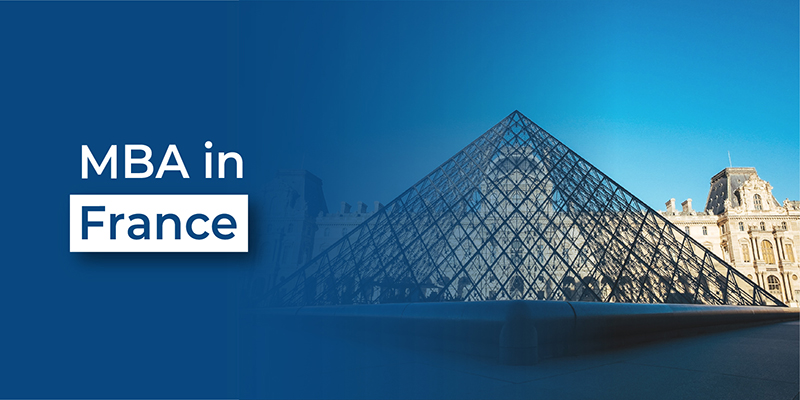
France is home to some of the world’s best MBA programs, which provide internationally renowned education, strong business links, and extensive networking possibilities. Whether you want to change careers, boost your progress, or start a business, these prominent business schools in France have the experience and tools to help you succeed in today’s competitive market.
Whether you want to work for a big firm or establish your own business, France has many opportunities for ambitious MBA graduates from top business schools in France. France not only has La Défense, Europe’s largest purpose-built commercial area, but it also functions as a strategic hub, providing access to vital European markets and industries in a wide range of sectors.
The question is less about why you should pursue an MBA in France and more about which business schools in France can help you take advantage of the opportunities available. To get you started, here is a list of the most popular business schools in France.
Table of Contents
Which are the best business schools in France?
France is home to some of the world’s most famous business institutions, including internationally acclaimed Master of Business Administration (MBA) programs. INSEAD and HEC Paris are frequently ranked among the world’s best, demonstrating France’s commitment to business excellence.
French MBA programs blend academic excellence, hands-on experience, and international networking. These programs assist students rise into leadership positions, change occupations, or start their own businesses.
Why is France a top destination for business education?
Students studying in business schools in France can immerse themselves in the country’s rich cultural legacy, world-renowned cuisine, and famous architecture. Cities known for their dynamic student culture, such as Paris and Nice, are routinely ranked as best student cities in the world.
- France’s status as a world-class economic power exposes pupils to a dynamic and diverse commercial environment. This thriving economy provides an ideal setting for hands-on learning and professional growth.
- Many business schools in France have close relationships with major worldwide firms, including Airbus, Total, Orange, LVMH, L’Oréal, and Danone. These connections offer students vital networking opportunities, internships, and job prospects.
- Studying in business schools in France combines academic quality with strong corporate relationships, a vibrant economy, and cultural enrichment.
France’s Business Schools Landscape
France is home to some of Europe’s most prestigious MBA programs, which rank among the top in the world. These programs prioritize hands-on learning, case studies, and corporate relationships.
Students graduate well-suited for executive positions in a variety of businesses. INSEAD and HEC Paris have won top Financial Times Global MBA Ranking spots for 2025.
Business schools in France are constantly updating their programs to reflect industry demands. Their programs target the consulting, finance, technology, and entrepreneurial industries.
Why study business in France?
In 2026, France will be Europe’s premier location for business education. Six French business schools in France were ranked in Europe’s Top 10 and 26 in the Top 100 by the Financial Times European Business Schools 2025 ranking, ahead of every other European country. French Grande École business schools are likewise at the top of the global master’s management education rankings.
So, what distinguishes the top business schools in France from those in the United Kingdom or Germany for business students?
- The Programme Grande École (PGE): This is an elite French master’s-level management degree that typically lasts two to three years and is offered at schools such as HEC, ESSEC, and ESCP. It combines a MiM with optional specialisations and is the basis for the majority of international rankings.
- Triple Crown accreditation: France is the country with the second-highest number of institutions that possess all three of the following accreditations: AACSB (Association to Advance Collegiate institutions of Business, based in the United States), AMBA (UK MBA Association), and EQUIS (European Quality Improvement System). The Triple Crown indicates constant quality in teaching, research, and employer outcomes.
- English-taught programmes: The majority of MBAs, MiMs, and Specialised Masters in English are offered by premier colleges. Campus France certifies that international students can enroll in various business programs without knowing French.
- Industry access: Paris is a global powerhouse for luxury (LVMH, Kering, Hermes, L’Oreal), finance (BNP Paribas, Societe Generale, AXA), and consulting firms (McKinsey, BCG, Bain), all of which aggressively recruit from these campuses.
- One-year MBA and two-year MiM: the European 10-month MBA structure saves a full year of tuition and lost salary compared to the US two-year model.
The Conférence des Grandes Écoles (CGE), the French authority that accredits Grande Écoles, only admits schools that have passed a stringent quality evaluation. If a school is CGE-accredited, you can trust its reputation.
Related Posts: Amazing Benefits of London Business School
The Best Reasons to Attend Business Schools in France
As of July 2025, 163 higher educational institutions in France had received the ‘Bienvenue en France’ mark, indicating their commitment to enhancing services and support for international students. This effort provides a smooth adjustment to student life and fosters a welcoming environment for students from all over the world.
Aside from simplifying your integration, studying in France has other appealing benefits.
1. Set ambitious international student mobility goals:
France intends to welcome 500,000 overseas students by 2027 with the ‘Bienvenue en France‘ project. This indicates the country’s determination to foster a varied and inclusive academic environment.
2. Recognition for French Higher Education Institutions:
In the 2025 QS World University Rankings by Subject, 80 French schools were ranked across 51 disciplines, keeping France in fourth place worldwide in terms of the number of institutions ranked. This demonstrates the country’s strong presence in a variety of academic subjects.
3. Scholarship Options:
Leading business schools in France provide a variety of scholarships and tuition waivers to overseas students, making higher education in France more affordable and readily available.
4. Post-Study Job Opportunities:
France provides post-study work visas, which allow international graduates to stay and work in the country. This offers important international work experience and improves employability in the global job market.
5. High retention and graduation rates:
France has remarkable retention and graduation rates, with 92% of overseas doctoral graduates finding work within a year of finishing their studies. This statistic demonstrates the success of French higher education in preparing students for the global labor market.
6. Enriched Cultural Experience:
Studying in France allows students to immerse themselves in the country’s art, history, and dynamic cultural life, improving their experience beyond the classroom.
To get the most out of higher education in France, choose the proper university or business school in France.
Eligibility and test requirements for business schools in France
International applicants must have a recognized bachelor’s degree for MiM and MSc applications, as well as 2-6 years of work experience for an MBA, according to the official admissions pages at hec.edu, insead.edu, and essec.edu (2026 intake). Most elite programs demand GMAT or GRE, whereas IELTS, TOEFL, or PTE demonstrate English proficiency for English-taught tracks.
For the Master of Management or MSc
- Bachelor’s degree from a recognized university or final-year enrollment.
- For elite schools, a strong academic record (typically 70%+ or first class) is required, while some schools accept the TAGE MAGE (French-style management test) or CAT through the Join a School in France route. IELTS 6.5+, TOEFL 90+, or PTE 60+ are accepted unless your degree was in English.
- Additional requirements include a motivation essay, CV, 1-2 letters of recommendation, and an interview.
Related Posts: BUSINESS PROCESS MANAGEMENT SOFTWARE TO BOOST BUSINESS
For MBA
- Bachelor’s degree plus 2-6 years of professional experience (INSEAD average is around 6 years).
- GMAT 680+ or equivalent GRE; exemptions available for non-elite schools. IELTS 7.0+ or TOEFL 100+.
- Essays demonstrating leadership and effect, CV, letters of recommendation, and panel interview
For BBA or undergraduate
- For BBA tracks at ESSEC, KEDGE, NEOMA, and IÉSEG: Class 12 (ideally 80% or higher), SAT or equivalent at some schools, IELTS 6.0+ or proof of English-medium proficiency, motivation letter, and entrance evaluation.
Most major business schools in France accept students who do not speak French, as the MiM, MBA, and Specialized Masters programs at HEC, INSEAD, ESCP, ESSEC, EDHEC, and emlyon are taught in English. Basic French still helps with internships and full-time employment.
How to apply to business schools in France?
Applying to an MBA program in France necessitates thorough preparation and strategy. Most schools look for a solid academic background, employment experience, and competitive GMAT or GRE scores. Proficiency in English or French is expected, with TOEFL or IELTS results being required.
Applications need a personal statement, recommendation letters, and interviews to determine leadership potential and professional aspirations. Schools look for people with international experience, extracurricular achievements, and great communication abilities.
Some programs include pre-MBA boot camps and networking opportunities to help students transition smoothly into their studies. Early applications increase your chances of receiving scholarships and financial help, so plan ahead of time.
Cost of pursuing an MBA in France
Tuition rates for top MBA schools in France range from €11,200 and €39,800 per semester. INSEAD and HEC Paris often have the highest tuition rates. Students in France spend between €1,000 and €1,200 per month on living expenditures, which include housing, food, and transportation.
Annual living expenses in France range from €10,000 to €29,000, depending on the city and lifestyle. Some universities also impose administrative fees, which increase overall expenditures.
Scholarships such as the Eiffel Excellence, Charpak, and HEC Paris MBA Scholarship help alleviate financial constraints. INSEAD Scholarships and other school-specific grants can also help overseas students manage their expenses.
Post-Study Work Visa after Studying in France
After finishing your education in France, you have numerous possibilities for extending your stay and pursuing employment prospects. If you have a Master’s degree or equivalent from a recognized business schools in France, you can apply for the ‘Job Search / Business Creation’ residence visa, which allows you to stay for up to 12 months to find work or create a business. You must apply within four years of graduating, and once working in your field, you can switch to a long-term work visa.
There is no specific student visa for bachelor’s degree graduates in France. To stay in France, you must first acquire a relevant employment offer and then apply for a work visa or continue your studies, such as completing a Master’s degree.
These alternatives allow you to pursue an international job, obtain useful experience, or stay linked with France after you finish your studies.
Global Career Prospects Following Study in France
France’s broad industrial base includes automotive, chemicals, metallurgy, electronics, and textiles, with important industrial clusters in Centre-Val de Loire, Nord-Pas-de-Calais, and Normandy. The country is also making strides in innovation and sustainability, as evidenced by TotalEnergies’ development into wind energy and EDF’s struggles in nuclear production.
Graduates benefit from France’s strategic location inside the European Union, which facilitates mobility and access to job possibilities across member states. Platforms like as Pôle Emploi and APEC provide job seekers with targeted listings to help them find work.
Popular Business Schools in France
1. Queen Mary University of London, Paris:
Queen Mary University of London (QMUL) opened its Paris campus in 2018, expanding its global reach beyond its five London campuses and a medical school in Malta. The Paris campus provides specialized postgraduate programs in conjunction with prestigious universities such as Panthéon-Sorbonne University. Located in the heart of Paris, the campus offers students access to a lively academic and cultural environment. QMUL Paris also supports professional development through its vast network of industry collaborations and alumni ties.
Popular Courses
- LLM in Banking and Finance Law.
- LLM in Comparative and International Dispute Resolution.
- LLM in Energy and Natural Resources Law
- LLM in Intellectual Property Law
- LLM in Technology, Media, and Telecommunications Law
- Sorbonne Law School – Queen Mary University of London Double LLM
2. Schiller International University, Paris:
Dr. Walter Leibrecht created Schiller International University (SIU) in 1964 with the goal of providing an American-style liberal arts education to European students. Its Paris campus, which opened in 1967 in the 8th arrondissement near the Arc de Triomphe, offers a bustling urban environment. The school promotes experiential learning and offers career help through its global network, which improves students’ professional opportunities.
Popular Courses
- Computer Science
- Data Science
- Global Finance
- International Business
- International Relations and Diplomacy
- International Marketing
- Business Analytics
- Applied Mathematics and AI
- Business Administration
Related Posts: How To Get Unsecured Business Loans For Startups
3. NEOMA Business School:
NEOMA Business School was founded in 2013 with the merger of Reims Management School (1928) and Rouen Business School (1871). The Reims campus mixes urban vibrancy with modern facilities while remaining near to Paris and the Champagne region’s history. The Rouen campus provides a peaceful, green environment with sophisticated learning facilities, a vibrant cultural life, and easy access to Paris.
Popular Courses
- Management
- Business Analytics
- Supply Chain Management.
- International Finance – Asset Management & Investment Research
- International Finance – Corporate Finance & Investment Banking
- International Finance – Financial Markets & Risk Management
- Marketing – Luxury Marketing
- Global Management
4. Skema Business School:
Skema Business School was established in 2009 by the merger of École Supérieure de Commerce de Lille (ESC Lille) and CERAM Business School (Sophia Antipolis). The Paris campus, located in Suresnes, is the historic site of Louis Blériot’s aeronautical manufacturing, which later served as Airbus’ headquarters. The campus values experiential learning and offers strong career development support through its vast industry network.
Popular Courses
- Global Management
- Artificial Intelligence and Business Transformation
- Corporate Finance Management
- Financial Market and Investments
- Digital Marketing and Artificial Intelligence
- Luxury & Fashion Management
- Sustainable Finance & Fintech
5. ESCE International Business School:

ESCE International Business School, established in 1968 by Business France, is a private business schools in France located in the heart of La Défense, Paris’ major business district. The Paris campus, located in the Coeur Défense building at 90-110 Esplanade du Général de Gaulle, provides a lively atmosphere for students working toward academic and professional goals. Students benefit from closeness to over 500 international companies, which expands their job options and industry connections.
Popular Courses
- Management – Corporate Finance
- Management – Financial Markets
- Global Supply Chain Management,
- International Business Development,
- Corporate Finance,
- International Marketing.
6. INSEEC Business School:
INSEEC Business School, founded in 1975 by José Soubiran in Bordeaux, is a private business schools in France accredited as a Grande École and a member of the OMNES Education group. The Paris campus, located at 37 Quai de Grenelle, Building Pollux, 75015 Paris, provides a variety of degrees in international business, digital marketing, and finance. The campus values experiential learning and offers strong career development support through its vast industry network.
Popular Courses
- International Business
- Grande Ecole (Master in Management)
- International Business Management
- International Management
- Luxury and Fashion Marketing & Customer Experience
- Marketing & Brand Management
7. Montpellier Business School:
Montpellier Business School (MBS) was founded in 1897 by the Montpellier Chamber of Commerce and Industry, making it one of the first business schools in France. The Paris campus, at 57 Boulevard Saint-Germain, 75005 Paris, has programs in International Business, Digital Marketing, and Finance. MBS is triple-accredited by AACSB, AMBA, and EQUIS, demonstrating its dedication to academic excellence. The Paris campus gives students access to a vibrant professional network and job prospects in the French city.
Popular Courses
- International Business Administration
- Grande Ecole – Management Program
- Big Data & Artificial Intelligence For Business
- Global Finance in a Sustainable World
- International Business
- Supply Chain Management
- Luxury Marketing in a Sustainable World
8. Rennes School of Business:
Rennes School of Business, founded in 1990 by the Rennes Chamber of Commerce and Industry, is a private business schools in France. The Paris campus, which will open in September 2021, is at 9 Rue d’Athènes, 75009 Paris, in the ninth arrondissement. The campus emphasizes experiential learning and provides significant career development support. It gives students access to a solid professional network, which helps them make vital industrial connections in France’s capital.
Popular Courses
- Data and Business Analysis
- Financial Data Intelligence
- International Accounting, Management Control, and Auditing
- International Finance
- International Management – Luxury Marketing
- International Management – Marketing
- Logistics, Supply Chain & Purchasing
- Luxury Marketing & Brand Management
9. KEDGE Business School:
KEDGE management School, formed in 2013 by the merger of Bordeaux Management School (BEM, founded in 1874) and Euromed Management (ESC Marseille, founded in 1872), is a leading French management school. The Paris campus, located at 40 Avenue des Terroirs de France, 75012 Paris, is housed in the Lumière Building, one of Paris’ main business areas. KEDGE is triple-accredited by AACSB, AMBA, and EQUIS, demonstrating its dedication to academic achievement.
Popular Courses
- International Business Administration,
- Banking and Finance,
- Data Analytics,
- Global Supply Chain Management,
- International Business MSc Marketing.
10. Burgundy School of Business:
The Burgundy School of Business (BSB) was established in 1899 by the Dijon Chamber of Commerce and Industry. The Paris campus, located at 17 Rue Juge, 75015 Paris, provides specialist studies in cultural industries and the wine and spirits business. BSB is triple-accredited by AACSB, AMBA, and EQUIS, ranking it in the top 1% of business schools worldwide. The Paris campus gives students access to a vibrant professional network and job prospects in the French city.
Popular Courses
- Management
- Artificial Intelligence & Digital Strategy Management
- Corporate Finance and Investment Banking
- International Business Development
- Luxury Management & Innovation
CONCLUSION
France has long perfected the blend of history and modernity. Its top business schools, many of which were founded more than a century ago as part of the country’s prestigious Grandes Écoles system, combine academic rigor with a global perspective that reflects today’s interconnected economy.
French MBA programs are totally taught in English, with peers from all over the world, and benefit from a culture that emphasizes critical thinking, innovation, and leadership. Students work on ideas that connect emerging and existing markets, getting exposure to the various economic, cultural, and social views that define global business today.
FAQ’S
How do Business Schools in France provide for housing on campus?
On-campus dorms are common at business schools in France, as is aid in securing private student housing nearby. Furnished rooms, shared kitchens, and study areas are common features of facilities. International offices at these colleges assist students in navigating rental agreements and ensuring a safe and comfortable living environment.
Do Business Schools in France offer English-taught programs?
Yes, most major colleges and business institutions in France provide English-taught programs, particularly at the master’s level. These programs are geared toward international students and frequently contain specialist courses in business, law, management, data science, and finance. English-taught programs provide students with a worldwide education while studying in France.
What types of student support services are offered at Business Schools in France?
Most universities and business schools offer complete student support services, such as academic advising, career guidance, mental health care, and language assistance. These services are intended to help international students adjust to academic and cultural life in France.
Do Business Schools in France offer opportunity for cultural and extracurricular activities?
Yes, students in France’s colleges and business schools can join clubs, student associations, sports, and cultural events. These programs help students integrate socially, develop leadership abilities, and experience French culture outside of the classroom.
How do Business Schools in France help students plan their careers after graduation?
Many business schools in France have specific career centers that provide internships, recruiting fairs, networking opportunities, and mentorship programs. These services assist students in finding work in France or throughout the world, as well as preparing them for professions in industries related to their studies.