








More universities are taking in international students in an effort to broaden diversity and embrace fresh viewpoints. As a result, more foreign students are seeking out universities that provide financial aid for foreign students to attend.
International students may benefit greatly from this, but it is frequently very expensive. Although not all schools offer financial aid to foreign students, it can help alleviate the expense. Which universities, then, provide financial aid for foreign students?
Continue reading for a comprehensive list of institutions and colleges that provide financial aid for foreign students as well as advice on what to consider when submitting an application.
Table of Contents
Financial Aid For Foreign Students

The United States spends USD 268.4 billion annually on sponsoring education at US colleges. Financial aid for foreign students at US institutions averaged USD 79,000 in 2024. At the same time, it was announced that the maximum amount of financial help available to international students was USD 86,258. Additionally, there are US universities that provide international students with full scholarship possibilities as well as half tuition grants.
Some US institutions may set aside money only for its local students, even though many give fair financial aid to foreign students wishing to study in the US. The several funding alternatives accessible at these institutions, especially for international students, will be covered in this article along with schools and universities that provide financial aid for foreign students.
Why Select Colleges and Universities That Provide Financial Aid?
Why should foreign students enroll in US colleges’ financial aid programs? The following five general justifications form the basis of the explanation:
- Studying in the US is costly, but tuition can be reduced by at least 20% with financial aid.
- There may be a 50–60% possibility that the student will receive some cash from the college because many US universities provide financial aid for foreign students.
- Living expenses in the USA will be easier to handle if the strain of studying there is reduced.
- Most schools offer renewable financial aid for foreign students; if not, international students receive reimbursement for their expenses at the conclusion of their studies.
- And lastly, international students can be qualified for a full tuition price waiver in certain circumstances; a partial tuition fee waiver is always an option.
Sources of Financial Aid for Foreign Students
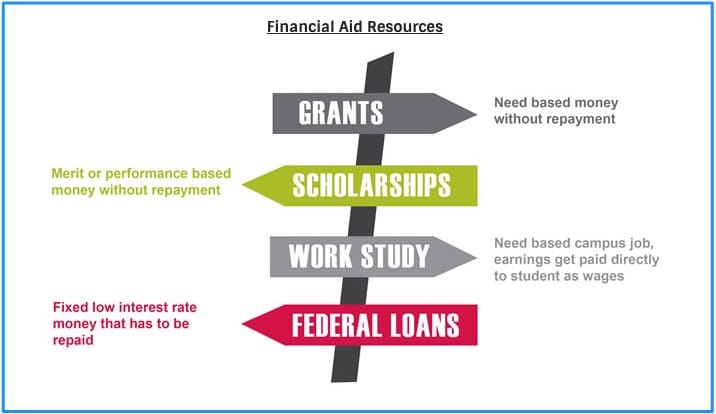
The application process for financial aid for foreign students is challenging. To begin, you can calculate the actual or total cost of the school by accounting for the entire cost, which includes accommodation, board, and tuition. Some of the methods that colleges and universities can offer financial aid for foreign students are listed below:
1. Scholarships:
Numerous universities provide scholarships tailored to international students, and institutions like the U.S. Department of State’s EducationUSA program provide even more. Remember that the GPA, test scores, and other prerequisites for scholarships are frequently very high. Visit U.S. College Scholarships for International Students to learn more about these scholarships.
While some scholarships are merit-based, meaning they are awarded based on your qualifications, others are need-based, meaning they are given to students depending on their financial situation. Certain universities provide international students with merit-based scholarships. For example, six foreign students are awarded the Full-Tuition Scholarships at Carleton College each year.
Scholarship Types for International Students
Before funding is even taken into consideration, candidates should be informed of the different kinds of international student scholarships offered in the USA, including some of the following categories:
- In the USA, academic merit, test scores (SAT, ACT, GRE, and GMAT), and general academic background are taken into consideration while awarding scholarships. These can be provided by foundations, private organizations, or universities.
- Applicants who demonstrate financial need are eligible for need-based scholarships. Harvard and Stanford are two examples of universities that provide need-based financial scholarships.
- Colleges and universities in the United States may grant scholarships tailored to their particular institutions. Each university has its own set of requirements for university-specific scholarships, which may take into account factors like the student’s country of origin, academic merit, or field of study. Separate applications are occasionally needed, such as the FAFSA student financial assistance form for needs-based scholarships.
- Government-funded scholarships are another type of scholarship offered by the US government. Some may be set aside for foreign students in addition to domestic students (US nationals).
- Scholarships to study in the United States are provided by foundations, businesses, and nonprofit organizations; these are commonly known as indirect or external scholarships. It takes a lot of effort to find opportunities because the scholarship requirements might differ greatly depending on factors like academic level, subject of study, or demographics.
- In the USA, scholarships for sports or athletics are also available. University-based sports scholarships are available to applicants who exhibit talent and fulfill academic standards.
- Program-specific scholarships are awarded based on an academic program, field of study, or research area.
Related: Easy Ways On How To Increase My GPA Fast
2. Financial aid for foreign students:
The terms “need-blind” and “need-aware” should also be familiar to you. When a college is “need-blind,” it does not consider your financial circumstances or whether you will require financial help when making admissions choices. If you are need-aware, the admissions process considers your need for financial aid. For American students, many universities are need-blind, but for foreign students, they are mindful of their needs.
Federal work-study is not available to international students, but some universities have their own work-study programs that you might be eligible for. There may be job restrictions, so don’t forget to consider the rules of your student visa.
3. Other Alternatives:
If the cost of college is a barrier, think about other options. For instance, you may start at a less expensive community college and then transfer, which would allow you to earn a degree from a more expensive institution or university while spending less time and money on tuition.
Schools That Give Financial Aid For Foreign Students
Financial aid to foreign students is provided by the schools below. They are arranged alphabetically within each state as well as by state.
Arizona
Arkansas
California
- Alliant International University
- ArtCenter College of Design
- Azusa Pacific University
- California Lutheran University
- California State University San Bernardino
- Claremont McKenna College
- Dominican University of California
- Menlo College
- Notre Dame de Namur University
- Occidental College
- Pepperdine University
- Saint Mary’s College of California
- Stanford University
- University of San Diego
- University of Southern California
- Whittier College
Colorado
Connecticut
Delaware
District of Columbia
Florida
- Eckerd College
- Florida Institute of Technology
- Florida Southern College
- Lynn University
- Northwood University
- Ringling School of Art and Design
- Rollins College
- Saint Leo University
- The University of Tampa
- University of Central Florida
- University of Miami
Georgia
Illinois
- Augustana College
- DePaul University
- Elmhurst College
- Illinois College
- Illinois Institute of Technology
- Illinois Wesleyan University
- Knox College
- Lake Forest College
- Northwestern University
- Saint Xavier University
- The School of the Art Institute of Chicago
- The University of Chicago
Indiana
- Ball State University
- Butler University
- DePauw University
- Earlham College
- Manchester College
- Purdue University
- Saint Mary’s College
- University of Evansville
- University of Southern Indiana
- Valparaiso University
Iowa
- Clarke College
- Cornell College
- Drake University
- Grinnell College
- Loras College
- Luther College
- University of Dubuque
- Wartburg College
Kentucky
Louisiana
Maryland
- College of Notre Dame of Maryland
- Goucher College
- Hood College
- Johns Hopkins University
- Maryland Institute College of Art
- St John’s College
- Washington College
Massachusetts
- American International College
- Amherst College
- Babson College
- Bentley College
- Boston University
- Brandeis University
- Clark University
- Dean College
- Emerson College
- Endicott College
- Hampshire College
- Harvard College
- MA College of Art
- Mount Ida College
- Northeastern University
- Regis College
- School of the Museum of Fine Arts, Boston
- Smith College
- Suffolk University
- The Art Institute of Boston at Lesley University
- The Boston Conservatory
- Tufts University
- Wellesley College
- Wentworth Institute of Technology
- Wheaton College
- Williams College
- Worcester Polytechnic Institute
Michigan
- Adrian College
- Albion College
- Calvin College
- College for Creative Studies
- Grand Valley State University
- Hope College
- Kalamazoo College
- Lawrence Technological University
Minnesota
- Carleton College
- College of Saint Benedict/Saint John’s University
- College of St Catherine
- Concordia College
- Hamline University
- Macalester College
- Minnesota State University Mankato
- St Olaf College
- The College of St Scholastica
Missouri
- Columbia College
- Culver Stockton College
- Saint Louis University
- Washington University in St Louis
- Webster University
Montana
Nebraska
New Hampshire
New Jersey
- Drew University
- Fairleigh Dickinson University
- Monmouth University
- Princeton University
- Stevens Institute of Technology
New Mexico
New York
- Adelphi University
- Bard College
- Berkeley College
- Clarkson University
- Colgate University
- Columbia University
- Cornell University
- D’Youville College
- Elmira College
- Eugene Lang College/New School University
- Fisher College
- Fordham University
- Hamilton College
- Hobart and William Smith Colleges
- Iona College
- Ithaca College
- Lally School of Management & Technology
- Manhattanville College
- Niagara University
- New York University
- Parsons the New School for Design, NY
- Rochester Institute of Technology
- School of Visual Arts
- Skidmore College
- St Lawrence University
- State University of New York-Plattsburgh
- Union College
- University of Rochester
- Utica College
- Vassar College
North Carolina
- Campbell University
- Davidson College
- Duke University
- Elon University
- Guilford College
- Methodist College
Ohio
- Antioch College
- Ashland University
- Denison University
- Hiram College
- Kenyon College
- Miami University
- Ohio Wesleyan University
- The College of Wooster
- Ohio State University
- University of Cincinnati
- Wittenberg University
- Xavier University
Oklahoma
Oregon
- George Fox University
- Lewis & Clark College
- Linfield College
- Reed College
- University of Oregon
- University of Portland
Pennsylvania
- Albright College
- Bryn Mawr College
- Bucknell University
- Chatham College
- Dickinson College
- Drexel University
- Duquesne University
- Elizabethtown College
- Franklin & Marshall College
- Gettysburg College
- Juniata College
- La Roche College
- Lafayette College
- Lebanon Valley College
- Lehigh University
- Marywood University
- Moravian College
- Seton-Hill University
- Shippensburg University of Pennsylvania
- Slippery Rock University of Pennsylvania
- Susquehanna University
- Swarthmore College
- The University of The Arts
- University of Pennsylvania
- Ursinus College
- Villanova University
- Widener University
Related: Best Universities In Cyprus For International Students
Rhode Island
- Brown University
- Bryant University
- Johnson & Wales University
- Roger Williams University
- Salve Regina University
Tennessee
- Belmont University
- Carson-Newman College
- Rhodes College
- Sewanee, The University of the South
- Vanderbilt University
Texas
- Rice University
- Southern Methodist University
- St Mary’s University, San Antonio
- Stephen F Austin State University
- Texas Christian University
- Trinity University
- University of Dallas
Vermont
Virginia
- George Mason University
- Randolph College
- Roanoke College
- Shenandoah University
- Sweet Briar College
- University of Richmond
- Virginia International University
- Washington and Lee University
Washington
Wisconsin
- Beloit College
- Lawrence University
- Marquette University
- St Norbert College
- University of Wisconsin-Eau Claire
- University of Wisconsin-Superior
FAQ’s
Do US institutions have to provide financial aid for foreign students?
No, financial aid for foreign students is not always required. Only a small number of foreign students are able to pass the competition, which is usually extremely difficult. Therefore, in order to demonstrate their eligibility for financial aid, international students should have valid arguments, appropriate documentation, and strong scholarship essays.
Do all American institutions offer scholarships to foreign students?
No, scholarships are not available at all US universities for international students.
What is the average GMAT cutoff in the United States for an MBA?
In the USA, the typical GMAT cutoff for an MBA is between 545 and 755. In light of this, applicants can pursue B-schools in the United States.
Conclusion
You can assess your chances of being accepted into different universities by looking at the schools mentioned above to get a basic idea of which ones would be a good fit for you. It might provide you with an overview of your chances, even though it’s not totally true that all of the schools may still provide financial aid for foreign students.